 |
 |
Morio The National Gallery in London |
National Gallery: 200th Anniversary
| By Roderick Conway Morris | LONDON 3 May 2024 |
In 1779 the writer and collector Horace Walpole wandered through the rooms of the splendid Palladian Houghton Hall in Norfolk, built by his father and Britain's first Prime Minister Sir Robert Walpole to accommodate his superb personal collection of Old Masters, including works by Rubens, Rembrandt, Van Dyck, Poussin, Luca Giordano and Murillo.
'I have lived to see the glorious collection of the pictures that were the principal ornaments of the house, gone to the North Pole,' Horace gloomily wrote to a friend, 'where it will be burnt in a royal palace at the first insurrection.'
The sale of Walpole's over 200 paintings to Catherine the Great and their dispatch to St. Petersburg caused a national outcry, led by the radical MP John Wilkes, who condemned his fellow parliamentarians for failing to purchase this 'national treasure'. Another observer declared that 'the removal of the Houghton Pictures to Russia is, perhaps, one of the most striking instances that can be produced of the decline of the empire of Great Britain.'
In the previous century the nation had already lost an even more magnificent collection, amassed by that greatest of royal connoisseurs, Charles I, which had been unceremoniously disposed of by the puritan Cromwell in the Commonwealth Sales of 1649-1651, and many of whose finest pieces now adorn the Louvre and the Prado.
During the 18th and early 19th century almost every country in Europe created a national picture museum. The Louvre was opened in 1793, the Rikjsmuseum (originally in The Hague) in Amsterdam in 1800 and the Prado in Madrid in 1819. The National Gallery established in 1824 was unusual in that it was a state rather than royal institution.
George III, the first Hanoverian with wide cultural interests bankrolled the Royal Academy in 1768. However, the members of the RA were the primary opponents of the very idea of a National Gallery. British artists feared that the promotion of foreign Old Master paintings would damage the market for the local wares of living ones. In 1799 the Irish painter James Barry was expelled from the Academy for advocating a national public gallery. And, when the outstanding collection of their first President, Sir Joshua Reynolds, was offered to them at a modest price after his death, they refused to buy it.
Following the Napoleonic Wars, influential figures who had travelled in Europe and admired the great galleries there more or less shamed Parliament into backing a similar enterprise at home. One such was Sir George Beaumont, a Leicestershire landowner and connoisseur, who made it known that if a National Gallery were created, he would leave his own important collection to it.
After another discerning collector, John Julius Angerstein, died in 1823 it was rumoured that the Prince of Orange had offered £70,000 for it. Beaumont announced that he would give sixteen of his paintings if Angerstein's were purchased. Parliament voted to pay Angerstein's son £60,000 for thirty-eight paintings and the house at 100 Pall Mall where they were displayed. The collection included an enormous 'Raising of Lazzarus' by Sebastiano del Piombo (designated NG 1), and works by Claude Lorrain, Raphael, Rubens, Rembrandt, Van Dyck and Hogarth.
When on 24 April 1824 the National Gallery was opened to the public in Angerstein's town house there was considerable pride in the democratic nature of this new British institution which, unlike most European collections, was free of charge and did not restrict access to certain classes - being, as a writer in the Quarterly Review noted, open 'to the indolent as well as to the busy - to the idle as well as the industrious'. Despite anxieties that some visitors might prove uncouth, the first Keeper William Seguier reported that 'all the people are very orderly and well-behaved.'
In 1826 the Chancellor of the Exchequer persuaded Parliament to spend £9,000 at the bankruptcy sale of a London jeweller, which yielded such gems as Titian's stunning 'Bacchus and Ariadne' and Poussin's 'Bacchanalian Revel Before a Term'.
It was suggested the growing collection might be moved to William Kent's Royal Mews in the area that was later to become Trafalgar Square, after a menagerie, including a giraffe, had been evicted. But it was then decided that the levelled site be used for a brand-new, purpose-built gallery.
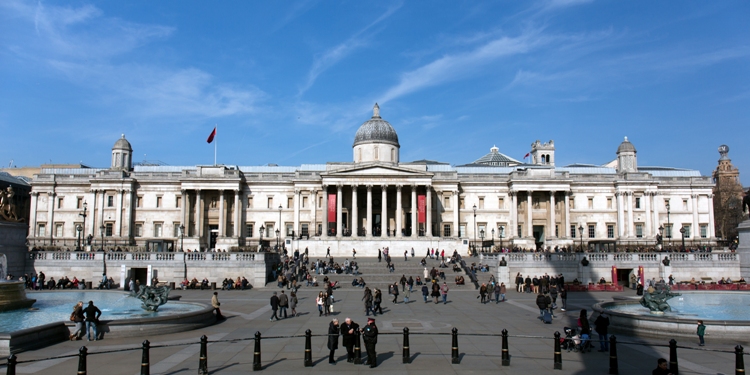
The designer chosen by public competition was the Greek Revival architect William Wilkins, whose earlier projects included new buildings for Downing College, Cambridge, and UCL, London. Wilkins's Gallery was finally opened by Queen Victoria in April 1838.
Although the location previously seemed hemmed in, the opening up of the new Trafalgar Square to the south gave the Gallery a suitably monumental setting and the demolition of St. George's Barracks and St. Martin's parish workhouse to the north provided sufficient room for the progressive expansion of new gallery spaces during the 19th and 20th centuries.
In its early days the development of the new Gallery was constrained by its forced co-habitation with the RA, the very organization that had tried to strangle it at birth, which was assigned the east wing of the edifice. This came to an end when the RA moved to its grandiose new premises at Burlington House on Piccadilly in 1869. Ironically, given Constable's vociferous opposition to the founding of the Gallery, his canvas 'The Cornfield' was the first picture to be donated, in his memory, by public subscription thanks to the 300 guineas raised by 113 private contributors after his death in 1837.
The Gallery was immensely popular with the public, attracting nearly a million visitors by 1859. Apart from the pictures, it was a place to escape the weather, to rest, and to make romantic assignations. In 1850 the Keeper Thomas Unwins came upon a group with picnic baskets and 'when I suggested to them the impropriety of such proceedings in such a place, they were good humoured, and a lady offered me a glass of gin.'
A former President of the RA Sir Charles Eastlake served as Director between 1855-65, bringing a new professionalism to the acquisition of pictures and their serious study. He travelled regularly to the Continent with his wife, Elizabeth, also a linguist and art expert, and made a series of brilliant purchases from hard-up aristocrats of impressive works by the likes of Duccio, Piero della Francesca, Uccello, Raphael, Bellini, Tintoretto, Veronese and Bronzino. He was also responsible for bagging the Gallery's three Van Eycks. In 1871 an extraordinary government grant of £75,000 secured from Sir Robert Peel's heirs his remarkable collection of nearly 70 Flemish and Dutch pictures, among them Hobbema's 'Avenue at Middelharnis'.
Successive directors found themselves at loggerheads with the often ultra-conservative aristocratic Trustees when it came to buying, or even receiving as gifts, modern art, such as the French Impressionists. But Sir Charles Holmes (Director, 1916-28) pulled off a coup when he obtained a special Treasury grant of £20,000 before attending the sale of Degas' collection in Paris in 1918, which Holmes attended incognito having shaved off his moustache. The auction continued despite the loud bombardment of the city by Big Bertha, the Germans' long-range gun, and Holmes refused to stop bidding for lots supposedly reserved for the Louvre, despite hissed demands to desist. He returned home bearing masterpieces by Ingres, Delacroix, Gauguin and Manet.
On the eve of the Second World War the Trustees proposed shipping the entire collection across the Atlantic, but Kenneth Clark (Director, 1934-45) appealed to Winston Churchill, who replied: 'Bury them in the bowels of the earth, but not a picture shall leave this island.' Clark did just that, transporting the collection to a slate mine at Blaenau Ffestiniog in North Wales for the duration. Among Clark's innovations were the installation of electric lighting in 1935, evening openings, a lecture room with a slide machine and temporary exhibitions.
In 1966 a preposterous GLC scheme to encircle the National Gallery with major arterial roads, which would have transformed it into 'a glorified traffic island', accessible only via subterranean passages, was mercifully abandoned.
More recently, plans for a major expansion to the west of Wilkins's original building were as contentious as any in its history. Numerous designs were proposed - the winning one including a neo-Art Deco glass tower, which was memorably described by the then Prince of Wales (who was also a Trustee) as 'a monstrous carbuncle on the face of a much loved and elegant friend' - a judgement shared by many, despite the mockery it invited from the belligerent modernist architectural establishment.
Fortunately, a gift of £30 million by Simon, John and Timothy Sainsbury to pay for a more harmonious design culminated in the opening in 1991 of the wing that now bears their name. The overall pleasing effect of the Wilkins and Sainsbury façades has since been enhanced by the pedestrianization of the north side of Trafalgar Square and the creation of a broad flight of steps leading up to the Gallery's main portico.
First published: The Lady
© Roderick Conway Morris 1975-2026