 |
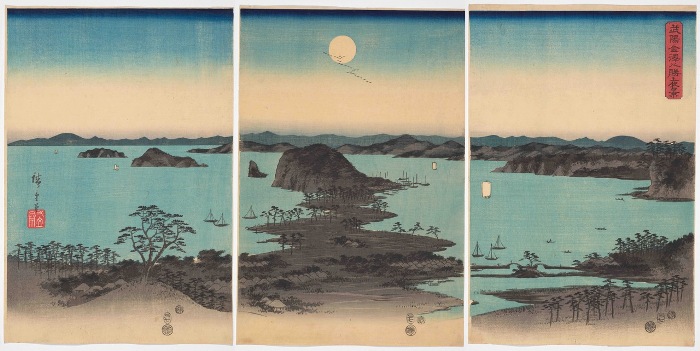 |
Collection of Alan Medaugh, New York Evening View of the Eight Scenic Spots of Kanazawa in Musashi Province by Utagawa Hiroshige,1857 |
Hiroshige: Artist of the Open Road
| By Roderick Conway Morris | LONDON 11 August 2025 |
In the world of popular prints 19th-century Japan was infinitely more colourful than the West, where almost all printed matter was monochrome. In the West, pictures could be duplicated mechanically on a massive scale, yet colour-printing remained expensive and its use limited. In Japan the perfection of hand-printing during the 18th century, using multiple blocks for the same image, enabled the production of millions of highly coloured pictures. And so cheap were these – the equivalent of two helpings of noodles – that even the humblest homes could afford to adorn their walls with coloured reproductions of famous actors, celebrated beauties and spectacular landscapes.
Although woodblock prints did not enjoy the same status as ink drawings and paintings, the genre attracted some of the country's greatest artists. One of the most renowned, then and now, was Katsushika Hokusai (1760–1849). Following in his footsteps was Utagawa Hiroshige (1797–1858), who would in due course become Hokusai's main rival.
'Hiroshige: artist of the open road', immaculately curated by Alfred Haft, is the first exhibition in London for over a quarter of a century to be entirely devoted to the artist, and the first ever at the British Museum. It is accompanied by a beautifully produced and enlightening catalogue, written by the curator. The occasion of the show is the donation to the museum of thirty-five Hiroshige prints from the collection of Alan Medaugh, and the temporary loan of a further eighty-two, most of which have never been publicly displayed before. The overall pristine quality of these carefully conserved works is simply astonishing, many of them seemingly almost freshly printed. The design of the exhibition is also attractive, with suspended hanging scroll-style backdrops for the prints, and makes a virtue of the often awkward curving outer wall of the Joseph Hotung Great Court Gallery.
Unlike Hokusai, who was a commoner, Hiroshige was born in Edo (now Tokyo) into a Samurai family, although a low-ranking one. The Tokugawa Shogunate's pacification of Japan had severely curtailed the usefulness of the martial classes and only a small proportion of Samurai were of independent means, and so, to support themselves, many took up arts and crafts – such as making umbrellas, fans, lanterns, lacquer – or breeding rare birds, decorative fish and plants.
Although Hiroshige held a hereditary position as a fire warden of Edo Castle, the seat of the ruling Shogun, it was not a lucrative one. He first studied classical painting but then found an apprenticeship, in around 1810–11, in the ukiyo-e (Floating World) milieu of Utagawa Toyohiro (1773–1828), learning to master designs for woodblock prints. And he carried over into this new medium the subtle gradations of colour he had learned from his classical training, a characteristic that came to be particularly admired in his prints.
In 1832 he resigned from his post as a fire warden to pursue his artistic career. His 'Nishonbashi – Morning Scene' shows a procession of high-ranking Samurai crossing this famous bridge in Edo, in the background of which can be seen a fire watchtower with alarm bell.
Hiroshige's early efforts revolved around the typical ukiyo-e subjects of fashionable beauties, courtesans, Kabuki actors and the life of the Yoshiwara pleasure district, but failed to distinguish him from the many other aspiring artists in this city with a population of over a million. At this time Hokusai was revolutionizing Japanese landscape painting with his 'Thirty-six Views of Mt. Fuji', which began publication in 1830. This was also a period of increasing interest in domestic travel and a new demand for images of meisho (famous places), not least for armchair travellers.
The Shogun's capital Edo was linked to Kyoto, the seat of the Emperor (whose role was then purely symbolic and ceremonial), by two principal highways, the Tokaido (eastern coast road) and the Nakasendo (inner road), both punctuated by post-houses and inns for travellers. The Tokaido was the most well trodden. As a prosperous inn-keeper at the Kawasaki Station declared in the early 1700s: 'Day and night carrying out the important business of the nation, the Tokaido is the greatest in the land.'
The Nakasendo, also known as the Kisokaido, since it ran through the river Kiso Valley and the wild mountainous region now known as the Japanese Alps, was partly developed as a strategic alternative to the coast road, which was vulnerable to attack from the sea. It was a more challenging route but rich in picturesque scenes for artists. Both roads became the subject of such publications as 'The Illustrated Guide to the Famous Places along the Tokaido' (1780) and 'The Illustrated Guide to Famous Places along the Kiso Road' (1805). Hiroshige and his fellow landscape artists made extensive but often imaginative use of these manuals, treating the illustrations with artistic licence to achieve more striking effects.
Hiroshige achieved his first significant success while in his mid-thirties with his 'Fifty-three Stations of the Tokaido' (1833–35). He received a rave review from the poet Yomo no Takisui, who wrote: 'These pictures make me feel as though I have travelled to the places myself and have viewed them in person, with never a moment's fatigue.'
In 1837 Hiroshige went on a sketching trip along the Kisokaido and then back to Edo on the Tokaido. The first 26 of his Sixty-nine Stations of the Kiso Highway (late 1830s) appear to have been done before he had traversed the route himself. For these he appears to have made judicious use of 'The Illustrated Guide to Famous Places along the Kiso Road'. The series as a whole contained some of his most memorable images, such as the hauntingly elegiac moonlit river view of the bridge at Nagakubo. At the 'Tarui' Station, the artist depicts the walls of tea houses decorated with ukiyo-e and landscape prints. And the ongoing competition between Hiroshige and Hokusai now spurred both artists to achieve ever greater things.
Around the same time as Hiroshige shifted his attention from the typical subjects of the Floating World to landscape, he also began to make close-up images of flowers, birds, trees, fish and other fauna and flora. Animistic reverence for nature is one of the most distinctive elements of Japanese culture. This, as Alfred Haft explains in the catalogue, was effectively codified by the court poet Ki no Tsurayuki (872–945) in the preface to his 'Collection of Japanese Poets Ancient and Modern' (c. 905), which was arranged under the seasonal headings of Spring, Summer, Autumn and Winter. As Haft writes: 'Tsurayuki formalised a set of nature-orientated aesthetic principles that have driven cultural expression in Japan for more than a millenium.'
Hiroshige was not only an artist but a highly cultivated poet and, as Haft remarks: 'His nature prints harmonise plants, animals and poetic inscriptions in an ideal expression of Tsurayuki's thought: each design opens a window onto an idealised time and place where nature, poetry and painting meet.' Aligning the series of blocks, with such minute gradations of colour as in the plumage of birds and the details of flowers, must have presented a challenge to even the most expert print makers.
Most consumers of inexpensive woodblock prints would have regarded them as ephemeral, soon to be replaced by the latest issue. Indeed, the first to reach the West had been used as wrapping paper for ceramics and other objects. But a discriminating number of local connoisseurs regarded the best of them as sufficiently collectable to preserve them for future generations.
Even less likely to come down to us were prints for uchiwa, rigid fans made from 70 slender, evenly spaced, bamboo ribs, onto which images were pasted front and back. Until recently these have been one of the least studied and exhibited of Hiroshige's works. He was the author of some 600–1000 of them, more than by any other artist. Unsurprisingly, given the wear and tear, many survive in unique examples, most of these never actually used. Yet they include some of Hiroshige's finest designs. Some two-thirds of his uchiwa prints are of meisho (famous places), for example, 'Dokan Hill in Edo', where three of the figures are depicted carrying such fans. In many of the designs, suggestively cooling stretches of water figure prominently. To enhance the effect, he made particularly lavish use of Prussian blue, which became available in Japan from the 1820s.
Hiroshige remained phenomenally productive until his sudden and unexpected death (possibly of cholera) at the age of 63 in 1858. His 'One Hundred Views of Edo', printed between 1856–58, with its 120 sheets, was the largest such series ever executed. It is estimated that some of his most popular prints were reproduced up to 15,000 times.
Nevertheless, he managed to die in debt. This may have been owing to his bon vivant personality – he was much in demand at cultured, convivial gatherings and celebrated for being able improvise brilliant drawings – and his generosity to his students, to whom he left his notebooks, brushes and other materials. In a hastily concocted will he first asked for a Samurai funeral, but then backtracked in view of the expense, apologising to his family for not providing better for them.
Hiroshige he died just four years before Japan, following 200 years of self-imposed isolation, re-established diplomatic and trading relations with the outside world, when the Shogunate came to end and the emperor re-asserted his authority, ushering in the Meiji era. He could hardly have been unaware of his immense influence on art in Japan through the modest medium of the woodblock print, but what he did not live to gain knowledge of was his transformational effect on many Western artists, which is the subject of the last section of this landmark exhibition and book, Van Gogh and Whistler being but two of the earliest beneficiaries.
Hiroshige: artist of the open road, British Museum, London, 1 May–7 September 2025
'Hiroshige: artist of the open road' by Alfred Haft, BM Press, 224 pp £30
A fully illustrated version of this article can be found at:
https://britishartjournal.co.uk/hiroshige-at-the-british-museum/
First published: British Art Journal: Online
© Roderick Conway Morris 1975-2026