 |
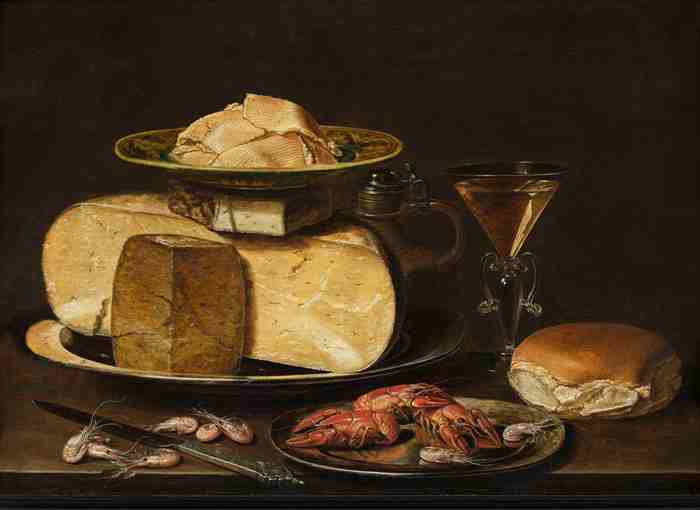 |
Private collection Still-life with Cheeses and Crayfish with Self-Portrait on the Lid of the Jug by Clara Peeters, c.1612–21 |
Women Artists in the Low Countries
| By Roderick Conway Morris | LONDON 21 May 2026 |
The first known self-portrait by an artist, male or female, depicted at their easel with palette and brushes was made by Catharina van Hemessen of Antwerp (1527/28–after 1567) in 1548. Presently, other men and women artists not only in the Low Countries but also in Italy adopted this device. One of the first to do so in the Dutch Republic was Judith Leyster of Haarlem (1609–60) in around 1630.
It has been estimated that over 8 million paintings were produced in the Dutch Republic during the Golden Age of the 17th century alone, not accounting for the prodigious production of works in the southern part of the region of Flanders in the Spanish Netherlands. A surprisingly high proportion of these were created by women artists, as is now witnessed by a landmark exhibition, 'Unforgettable: Women Artists from Antwerp to Amsterdam, 1600–1750', which has travelled on from the National Museum of Women in the Arts, Washington, D.C. to Ghent in Belgium, curated by Virginia Treanor and Frederica Van Dam, with the assistance of experts from both sides of the Atlantic.
The exhibition brings together a record of over 100 pieces by some 50 women artists, across multiple genres from portraiture and history painting to still-life and landscape, while a further 100 others are referenced and illustrated in the catalogue. It also emerges that, in addition to women art dealers, some women painters bought and sold art. The primary revelation of this event is the outstanding quality of many works whose makers were renowned in their lifetimes and celebrated in contemporary written sources, but who have gradually been erased from the record by subsequent generations of (overwhelmingly male) art historians.
How and why most of them later fell into obscurity is a recurring theme of the impressively researched essays by the more than a dozen contributors to the catalogue. Subsequent misattributions were one of the most perennial causes for women artists' disappearance from the record, even when works by them remained known and on display. Catharina van Hemessen perspicaciously added to the foot of her pioneering self-portrait: 'I Caterina Hemessen have painted myself/1548/Her age 20'. However, such captions fell out of fashion and the frequency with which even women's self-portraits were later regularly rebadged as portraits by (typically inferior) male artists indicates the scale of the problem.
In societies where most callings were closed to women the entrées into the art world were severely limited. Family connections were often the only available route both in terms of training and of marketing works. Many female painters were the daughters of artists. Others, who were financially privileged enough could afford to employ masters to instruct them. Whether women could join artists' guilds varied from place to place, but widows and unmarried daughters of artists were often accepted without having to pass through an apprenticeship.
Nor was Hemessen the only woman innovator. Clara Peeters (1587–after 1636), who was probably based in Antwerp, was one of the earliest and most brilliant still-life specialists and likely the first to feature fish as a subject. She inserted minute self-portraits of herself at her easel, reflected in glass, metal and pewter. The technique had been invented by Jan van Eyck some two centuries earlier, suggesting that Peeters was not only a virtuoso but also erudite. She was possibly the first woman painter to produce works for the open market.
Maria van Oosterwijck (1630–93) in her dazzling 'Vanitas Still-life' of 1668, painted for the Holy Roman Emperor Leopold I, reflected herself in a bottle at her easel - her only known self-portrait. She is recorded as having chosen to remain single to devote herself to painting and was sufficiently well-off to have domestic staff. Arnold Houbraken (1660–1719) noted in his 'The Great Theatre of Dutch Painters and Paintresses' (1718), the most important contemporary compendium of artists' biographies (which includes 24 women), that Van Oosterwijck was 'modest and exceptionally religious, but nevertheless happy and unusually diligent in the pursuit of her art'. Houbraken added that her painting was 'so beloved that most courts in which the love of art dwells became enamoured with it.' Indeed, her works could be found in the collections of Louis IVX, John III Sobieski, King of Poland, and William III of Orange.
One of Van Oosterwijk's most praised skills was her renderings of flowers, a striking element in her 'Vanitas Still-life', which earned her the epithet 'the queen of flowers.' Flower painting as a separate genre began in the Southern Netherlands in around 1600 thanks to the Antwerp painter Jan Breughel the Elder and others. Gerard de Lairesse (1614–1711) observed of the genre in his 'Great Book of Painting' (1707) 'that among many choices in the art of painting, none is more feminine, or proper for women than this.' Nonetheless, while there were many female specialists in this pursuit, there were also many men, since the demand for such pictures was enormous throughout the Low Countries and could guarantee a steady income.
Perhaps the most successful of all the floral artists of the long 17th century was Rachel Ruysch (1664–1750). The daughter of an anatomist and botanist father and a mother who was the daughter of the architect and painter Pieter Post (1608–1669), her compositions were fascinating combinations of blooms, fruits, insects, amphibians and reptiles, executed with consummate skill and panache. Her works fetched high prices and were commissioned by the likes of the great collector Johann Wilhelm, Elector Palatine in Düsseldorf - for whom she was contracted to deliver a painting every year - and circulated in the courts of Europe as diplomatic gifts. Her painting style was still developing into her seventies and she was at her easel at the age of 83.
It was almost impossible throughout this period for women to become sculptors, with the glowing exception of Maria Faydherbe (1587–after 1633) in Mechelen in Flanders, a centre for small religious statues since the 12th century. Her elder brothers were a sculptor and gilder respectively so she was not obliged to pay guild dues. In 1632 she denounced her fellow practitioners as dozijnwerckers (hack workers) and proposed a public competition to carve in wood and stone to prove who was the 'most artful'. Her pieces are superb, as demonstrated by her 'Crucifix' (1625-50), the cross for which has been lost. While Mechelen sculptors rarely signed their works, Maria did so either in full (as she did on the back of this crucifix: MARIA FAIDHERBE ME FECIT) or with her monogram.
In the applied arts armies of anonymous girls and women were employed in the making of lace. The results of their labours constituted one of the Southern Netherlands' most important exports, their productions reaching markets all over Europe, the Americas and Asia, yet the profits went almost entirely to middlemen. Although pattern books were often the work of named men, they did not necessarily take account of the complexities involved in realizing designs, and the technical advances in the art, such as new methods of making bobbin lace, seem almost wholly the work of highly-skilled but anonymous women. Interpreting designs was also rendered even more challenging by the fact that colour-coded systems for lace diagrams were not invented until 1911. Lace makers became one of the favourite subjects of male Dutch genre painters. But Judith Leyster provided an ambiguous and possibly satirical view of such idealized scenes in her 'Young Woman Being Harrassed by a Man' (1631).
The most spectacular rediscovery of a forgotten woman artist of recent years is that of Michaelina Wautier (c. 1614–1689) now the subject of a timely exhibition at the Royal Academy in London, curated by Gerlinde Gruber and Julien Domercq. It comes on from the Kunsthistorisches Museum in Vienna, which has four canvases by the artist in their permanent collection, including her magnificent 'Triumph of Bacchus'.
Michaelina was the subject of a revelatory exhibition in Antwerp in 2018, curated by Katlijne Van der Stighelen, the tireless scholar most responsible for the rediscovery of this marvellous painter and author of the first monograph on her, published to accompany the Antwerp show, and a co-author of the RA/Kunsthistorisches Museum exhibition catalogue.
One of the hopes of the Antwerp event was that it would lead to the identification of other lost works and that more information relating to Michaelina's biography and milieu might be forthcoming. This has indeed come to pass, one of the most important finds being the artist's series of 'Five Senses' canvases, which was brought to auction from a private collection in 2020 and is on loan to the current show.
The RA exhibition opens with an arrestingly large and assured 'Self-portrait' (c. 1650). In a tradition that went back to the very first such self-portrait by Catharina van Hemessen, Michaelina depicts herself in her finery - costly oyster-grey silk dress, black velvet wrap and pearls - rather than her painting outfit, reflecting her elevated social status rather than her chosen profession.
It appears that the canvas was on display at Althorp House, seat of the Spencer family, for some two hundred years from the early 18th century. In a text-book example of how misattributions have distorted the story of women's art, by the mid 19th century it had been declared a self-portrait by Artemisia Gentileschi, an opinion unaccountably endorsed by the Italian art historian Roberto Longhi in 1913. But by the time it was auctioned in New York in 1989, it had been deemed a 'Portrait of Anna Maria van Schurman' by an obscure male Dutch artist.
Michaelina was born in Mons in around 1614, one of seven children of her father Charles's second marriage. Although not noble, the family was wealthy and well connected. A younger brother, also Charles (1609–1703), became a painter too and the siblings seem to have spent most of their lives together, almost certainly sharing a studio. They appear to have been the first in their family to pursue artistic careers and must have received private instruction from unknown masters. There is good reason to believe they spent time in Italy, in view of their styles of painting and their use of a reddish ground in some of their works (typical south of the Alps). When Charles finally joined the Brussels guild of painters at the age of 33, it was recorded that he had trained 'abroad'.
Considering their high status, it is remarkable how little documentation has so far come to light regarding the family. An initial obstacle has been the plethora of spellings of their not uncommon family name: Waurthier, Wooters, Votier, Vautier and so on. The artist would have been known as Michelle, but she adopted Michaelina, the Latinized version of it, as her nom d'artiste. This version first appears in her 'Portrait of Andrea Cantelmo', which survives only as an engraving (1643). Happily, we currently have 10 signed and dated canvases by her, which have proved essential markers in tracing her career that appears to have spanned around 16 years between 1643 and 1659.
The rediscovery of Michaelina is especially significant because her work, unlike that of most of her contemporaries male or female, was so accomplished across so many fields, from portraiture and history painting to flower and genre pictures. The commissions she received for portraits alone suggest she had connections with elite circles at the Habsburg court in Brussels. A brother Pierre, who had been settled in the capital as early as the 1630s as the captain of a Walloon cavalry unit, may well have provided invaluable introductions. The family also had relations over many years with the Jesuits, who were familiar figures in court circles. This could have been a factor in the commission for the artist's powerful portrait of the Jesuit missionary Martino Martini in Chinese dress. He had been responsible for the first printed atlas of China, which he dedicated to Archduke Leopold Wilhelm (1614–1662).
The Archduke was known to be a particular friend of the Jesuits, who shared his enthusiasm for music, theatre and art. His installation as the governor of the Spanish Netherlands in 1647 very likely helped to create a cultured environment in which Michaelina's talents could thrive. In the Southern Netherlands the dominance of the Catholic Church in the dispensing of commissions for religious art made it difficult if not impossible for women to secure them, but in court circles ideas were perhaps more advanced.
Michaelina's first history painting, 'The Mystic Marriage of St. Catherine' was made not long after the Archduke's arrival in Brussels. She signed it: 'Michaelina Wautier invenit et fecit 1649', making it clear that both the conception of the composition and its execution were entirely her own work. Another such picture, 'The Education of the Virgin', is signed in an identical manner with the date 1656. She also did a series of three-quarter-length studies of saints, three of which were bought by the Archduke, who took them back to Vienna when he returned there with his collection in 1656.
A notable feature of the artist's religious pictures is her brilliantly observed images of young children, unquestionably taken from life. She did many of these, more often of boys but also of girls, genre pictures for which there was clearly a demand. It has previously been proposed that she might have been influenced in the style of these by Michael Sweerts (1618–1664), who was in Brussels during the same period. But the dating of Michaelina's genre paintings of this type, and the rediscovered 'Five Senses' (1650) in particular, now suggest that it was Sweerts, who did not return from Rome until about 1655, who was inspired by Wautier.
Michaelina's supreme masterpiece featuring children, 'Two Girls as Saints Agnes and Dorothy' (c. 1655) brings together in this extraordinarily atmospheric, subtly melancholic canvas her mastery of portraiture, genre and history painting. It is currently one of the stars of the Women Artists exhibition in Ghent (see above), but will be restored to its permanent home at the Royal Museum of Fine Arts in Antwerp
It was probably the Archduke himself who commissioned Michaelina's most ambitious history painting of all, her enormous 'Triumph of Bacchus', which contains over a dozen life-sized figures and is replete with literary and artistic references. It was probably painted between 1655 and 1659, in which case it would have been dispatched to Vienna after Leopold had left Brussels.
Over time Michaelina's name became detached from it. In 1797 it was assigned to 'School of Rubens'; in 1875 to Luca Giordano (1634–1705); while the 1892 Kunsthistorisches Museum catalogue ascribed it to Cornelis Schut (1597–1655). During the 1960s Günther Heinz (1927–1992), curator at the Museum, attributed the picture to Michaelina on stylistic grounds, dissenting from the earlier opinion of the Rubens scholar Gustav Glück (1871–1952), who had averred that he 'did not believe that such a large canvas could have been entrusted to a woman's hand.'
She did not sign it, but included what is clearly intended to be a kind of self-portrait – not too literal to save her own blushes, given the figure's daringly bared breast. But this exuberant, richly colourful, diverting, witty and beautifully composed and executed work marks her own final triumph as an artist.
Unforgettable: Women Artists from Antwerp to Amsterdam, 1600–1750',
National Museum of Women in the Arts, Washington, D.C., 26 September, 2025–11 January, 2026
Museum of Fine Arts, Ghent, 7 March–31 May, 2026
'Unforgettable: Women Artists from Antwerp to Amsterdam, 1600–1750' by Virginia Treanor and Frederica Van Dam (editors), Hannibal, 284 pp €59
Michaelina Wautier, Kunsthistorisches Museum, Vienna, 30 September, 2025–22 February, 2026, Royal Academy, London, 27 March–21 June, 2026
'Michaelina Wautier' by Gerlinde Gruber, Katlijne Van de Stighelen and Julien Domercq (editors), Kunsthistorisches Museum/RA, pp 192 £25
A fully illustrated version of this article can be found at:
https://britishartjournal.co.uk/women-artists/
First published: British Art Journal: Online
© Roderick Conway Morris 1975-2026