 |
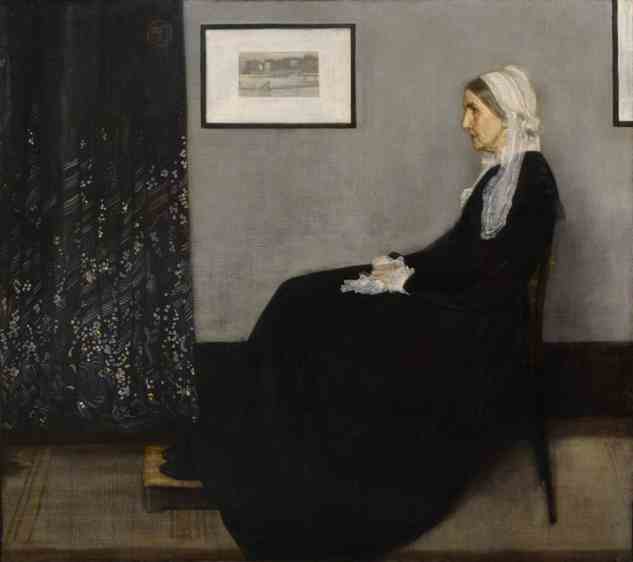 |
Musée d'Orsay, Paris Arrangement in Grey and Black: Portrait of the Painter's Mother by J.M. Whistler, 1871. |
James McNeill Whistler
| By Roderick Conway Morris | LONDON 6 August 2026 |
The American-born James McNeill Whistler (1834–1903) made England his principal home at the age of twenty-five. He won many admirers in France, and Henri Fantin-Latour (1836–1904) placed him centre stage in 'Homage to Delacroix', his 1864 group portrait of the leading artistic and literary lights of the Parisian scene. Whistler's 'Arrangement in Grey and Black: Portrait of the Painter's Mother' was bought in 1891 by the Musée du Luxembourg in Paris, where it was hung in the Salle d'honneur with Manet's 'Olympia' (1863).
In his adopted homeland, as in France, Whistler did not lack appreciation among his fellow artists but largely failed to impress the critics and the wider public. A rare exception was Frank Rutter, critic of the 'Sunday Times' from 1903 until 1937, who two years after the artist's death lauded 'the infinite variety of Whistler's genius' and declared that he had 'enlarged the boundaries of every medium he handled'. But although the Glasgow Corporation purchased his 'Arrangement in Grey and Black: Portrait of Thomas Carlyle No. 2' (1872–73) in 1891, not a single one of Whistler's paintings was bought by a public collection in England during his lifetime.
Whistler is now the subject of the first major retrospective in Europe for some 30 years (it moves on from Tate Britain to the Van Gogh Museum in Amsterdam and the Mesdag Collection at The Hague, with different titles and some changes in the exhibits). It is unprecedented in its scope and includes youthful sketchbooks and drawings never before shown, early portraits not displayed together since the memorial exhibition in 1905, and half of his 32 Nocturnes. The London exhibition is stylishly curated by Carol Jacobi, whose own excellent essays in the catalogue are joined by contributions from a score of international scholars exploring different aspects of Whistler's life and work.
Whistler was born in Lowell, Massachusetts, but when he was nine his father, Major George Washington Whistler (1800–1849), took the family to St Petersburg, where he was engaged to oversee the construction of a railway linking the then capital to Moscow. On arrival in Russia the young Whistler was presented with a cloth-bound sketchbook (on show here), which he soon began to fill with drawings and watercolours. He also received private lessons from an art student at the Imperial Academy of Fine Arts.
On the sudden death of his father, his mother, Anna, moved the family back to the US where, following in his father's footsteps, he attended the Military Academy at West Point (1851–54). There he was taught by Robert Walter Weir (1803–1889), the first American to be made the Academy's Professor of Drawing, who had reformed and broadened the curriculum to embrace the study of painters such as Turner (1775–1851) and Thomas Cole (1801–1848). Weir recorded of his student: 'He drew beautifully and rapidly with a pen and had a fine eye for colour.' Whistler's breaches of discipline and his failure in the chemistry examination led to his expulsion from the Academy. Nonetheless, when he sent his published account of the libel trial, 'Whistler v. Ruskin: Art & Art Critics' to the college's Library in 1879, he inscribed it 'From an old cadet whose pride it is to remember his West Point Days'.
This setback turned out to be a blessing in disguise when his drawing skills won him a post as a draughtsman in the US Coast Survey, where he received rigorous instruction in etching. One of his tasks was to produce a map and view of Anacapa Island in the Santa Barbara Channel, which had recently been annexed by the State of California. He was reprimanded for enlivening the view of the island's cliffs with two flocks of seagulls. There can be little doubt that his early training in etching was instrumental in giving him the confidence – he preferred to work directly onto the plates outdoors – to expand the expressive boundaries of this particular medium. That he was especially satisfied with 'Black Lion Wharf' (1859) is suggested by the fact that it appears on the wall in the portrait of his mother.
In 1855, at the age of twenty-one, Whistler received a modest allowance to go to study in Paris, where he enrolled at the École Impériale et Spéciale de Dessin. Over the next three years he shuttled between Paris and London. In the former he immersed himself in the local bohemian life, made etchings of the Latin Quarter and struck up friendships with the likes of Fantin-Latour. In London he stayed with his half-sister Deborah and her husband Francis Seymour Haden (1818–1910), the English surgeon and pioneering etcher. While there, he painted At the Piano (1858–59), of Deborah at the keyboard) with her daughter, Annie.
Music was central to the Whistler family's life and profoundly influenced the artist's conception of his own paintings and reflected in his styling individual pieces as an 'Arrangement', 'Symphony', 'Harmony' and 'Nocturne'. At the Piano was the first of his works to be exhibited at the RA and in Paris, and its bravado brushwork and bold colour contrasts aroused interest in progressive artistic circles on both sides of the Channel. It also won him his first patron, the Greek shipowner and Consul-General in London, Alexander Constantine Ionides (1810–1890), who commissioned a landscape and portrait of his son.
The artist, like a number of his contemporaries such as his friend Edgar Degas (1834–1917), was drawn to urban subjects: Charles Baudelaire (1821–1867), in a review, characterized Whistler's etchings as a 'deep and complicated poetry of a vast capital'. The artist was also attracted to watery themes, but not of a conventionally marine nature.
In 1859 he settled in London, taking up residence in Wapping, which became the setting for his most ambitious oil to date. It depicted his then partner Joanna Hifferman (1843–1886), the artist Alphonse Legros (1837–1911) and an unidentified figure at a rough pub, 'The Angel' at Rotherhithe, amid the bustle of the Pool of London, the world's busiest port. Whistler wrote to Fantin-Latour: 'I have never attempted such a difficult subject because as the boats leave I have only just time to put in their shades of colour.' He also tellingly described the background as 'like an etching'. Indeed, at this time he was also beginning his brilliant series of etchings of the Thames and the men and women who worked on the river and frequented its banks.
In 1866 he went on a joint expedition to Valparaíso in Chile with his younger brother, William McNeill Whistler (1836–1900), who had served during the American Civil War as a military surgeon on the Confederate side. The purpose of this adventure was probably to help supply arms to the Chileans, who had liberated themselves from their imperial Spanish masters, but the episode remains shrouded in mystery. When the Spanish navy bombarded the city and the population fled inland to the hills, Whistler self-deprecatingly recorded that as 'a West Point man I led the procession'.
As Miguel Gaete notes in his essay in the catalogue, 'Aesthetic Mercenary: Whistler in Valparaíso', the journey seems to have proved a liberating experience for the artist in freeing up his style and his approach to his work. Significantly, it also formed the basis for a canvas later entitled Nocturne in Blue and Gold: Valparaíso Bay (1866–74), now at the Freer Gallery in Washington, which should surely be considered the prototype of all his subsequent paintings bearing this particular musical title. Gaete acutely points out that Valparaíso's camanchaca, a marine mist that blankets the city and coast, may well have alerted the artist to the atmospheric artistic effects offered by the fogs that regularly descended on the Thames.
On returning to London, Whistler moved upriver to Chelsea, where he was welcomed by the Pre-Raphaelites and especially Dante Gabriel Rossetti, who lived close by at 16 Cheyne Walk and shared his passion for Asian and Japanese art. The south bank of the Thames across the water was already industrialized with factories and workshops, and the flow of the stream, which was then shallower, was even slower and more fetid than downriver. Yet Whistler discovered on his nocturnal walks and excursions by boat that, 'when evening mist clothes the riverside with poetry, as with a veil – and the poor buildings lose themselves in the dim sky – and the tall chimneys become campanili and the warehouses are palaces in the night', a magic could be found in these vistas that had escaped the majority of the city's population (Pl 2). On a visit to Brussels in 1887 he remarked: 'I will have to invent their town for them as I did the Thames for the Londoner!'
None of the Nocturnes was made on commission. The first two London examples, Nocturne: Blue and Silver – Chelsea 1871 and Nocturne: Blue and Silver – Chelsea 1871–2 (Harvard Art Museums) were on wooden panels, but he subsequently turned to painting them on canvas. The exhibition offers a welcome opportunity to examine a substantial number of these widely dispersed works up close, which reveals how much the artist varied his brushwork and paints to achieve different effects and textures. He employed a variety of concoctions of his own creation, which he called 'sauces'.
Recent analysis of the four Nocturnes in Harvard has demonstrated the complexity of these cocktails and their multi-layered applications. Additional ingredients included linseed oil, turpentine, Pinacean resin and oil and bleached shellac. While spreading the liquids the artist had to work flat to avoid the paints' dripping. The instability of these unconventional admixtures meant that some of these works needed maintenance during the artist's lifetime, and they present conservation challenges today.
Whistler was producing his first Nocturnes contemporaneously with the portrait of his mother, which famously he only embarked on when a model failed to turn up. But he saw these and all his other works as part of a single continuum striving to achieve certain aesthetic ends through the artful arrangement of colours. This also extended to his designs for interiors. As he wrote in a letter in 1887 to his friend the French art critic Théodore Duret (1838–1927), 'You know that I attach quite as much importance to my decorative 'arrangements' as to my pictures.'
Kenneth John Myers's exemplary essay in the catalogue, 'Whistler and the Art of Design: Rooms, Exhibitions, Frames' makes clear how regrettable it is that, of his many influential interiors, only 'Harmony in Blue and Gold: The Peacock Room' 1876–7 is now preserved, at the Freer Gallery of Art in Washington. The artist's genius for design made the exhibitions he staged of his own works events like no others. His 'Arrangement in White & Yellow' at the Fine Art Gallery in London in 1883 for a show of his recent etchings was the first to be given a formal title. The gallery attendant was dressed in a white suit with a yellow waistcoat and visitors were encouraged to harmonize themselves with the installation by wearing matching attire, yellow kerchiefs, cravats and butttonholes. The 'White & Yellow' exhibition went on to New York, Baltimore, Boston, Philadelphia, Detroit and Chicago.
Whistler painted portraits throughout his life for personal and commercial reasons – although his paradoxical mixture of a determination continually to experiment and a perfectionism made him ill suited to satisfy paying clients. There is here an exceptional gathering of portraits and self-portraits spanning his entire career, including a spectacular array of late full-length portraits in the final room. His portrait of his Irish mistress and model Joanna Hifferman, The White Girl, enjoyed a succès de scandale along with Manet's 'Déjeuner sur l'herbe' (1862–63) at the Salon des Refusés in Paris in 1863. It was followed by two others of Hifferman, 'Symphony in White No. 2: The Little White Girl' and 'Symphony in White No. 3' (1865–67).
Not a few of Whistler's subjects experienced the full force of the artist's credo that 'a picture is finished when all trace of the means used to bring about the end has disappeared'. The eight-year-old daughter of the banker and collector WC Alexander had to attend the artist's studio 70 times for what must have seemed, to her at least, the ironically entitled 'Harmony in Grey and Green: Miss Cecily Alexander'. She later recalled: ''I'm afraid I rather considered that I was a victim all through the sittings, or rather standings, for he never let me change my position, and I believe I used to get very tired and cross and often finished the day in tears'.
Nor was age or rank any defence against Whistler's insistence on prolonged and multiple sittings (or more typically 'standings'), or his habit of delaying the delivery of portraits and recalling them for 'touches' of repainting and reframing. The millionaire art collector George W Vanderbilt (1862–1914) first sat for him in 1897 and paid half the £2000 fee the following year yet, despite further sittings, the picture was still at Whistler's studio awaiting completion at the time of his death in 1903.
James McNeill Whistler, Tate Britain, London, 21 May–27 September 2026
Whistler: Dandy and Disruptor, Van Gogh Museum, Amsterdam, 16 October 2026–10 January 2027
Whistler: Loving the Netherlands
Mesdag Collection, The Hague, 16 October 2026–10 January 2027
'James McNeill Whistler' by Carol Jacobi (editor), Tate Publishing, 224 pp £32
A fully illustrated version of this article can be found at:
https://britishartjournal.co.uk/whistler-on-show/
First published: Bristish Art Journal: Online
© Roderick Conway Morris 1975-2026