 |
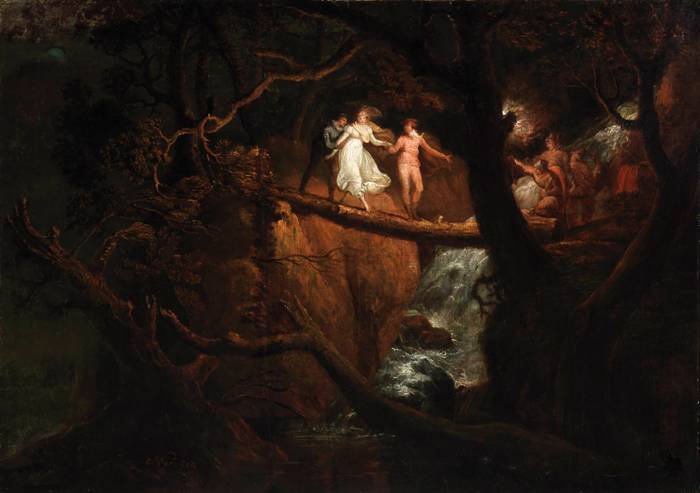 |
National Gallery of Ireland, Dublin Lady Blanche Crosses the Ravine Guided by the Count and St. Foix (A Scene from 'The Mysteries of Udolpho') by Nathaniel Grogan,1796–98 |
The Age of Romantic Fantasy
| By Roderick Conway Morris | DUBLIN 29 July 2026 |
As a child, William Blake (1757–1827) famously had a vision of 'a tree filled with angels, bright angelic wings bespangling every bough like stars', according to his biographer Alexander Gilchrist (1826–1861).
Had the English artist and poet ever ventured to Ireland, especially to the Gaeltacht, he would surely have encountered folk with similar experiences. As Lady Speranza Wilde (1821–1896), related in her 'Ancient Legends, Mystic Charms, and Superstitions of Ireland. With Sketches of the Irish Past', the western islanders believed not only in the little people 'but also that the angels are constantly present amongst them, and all blessed things – the rain, and the dew, and the green crops – come from their power'. The book was the subject of a glowing anonymous review written by her son Oscar for the 'Pall Mall Gazette' in 1887, in which he omits to declare the family connection.
Blake was pretty much unknown in Ireland at that time but, just six years after the publication of Lady Wilde's book, W.B. Yeats (1865–1939) co-edited Blake's poetry and attempted to establish his Irish ancestry (a claim now regarded as fanciful). The editors asserted in their introduction: 'The very manner of Blake's writing has an Irish flavour, a lofty extravagance of invention and epithet, recalling Tain Bo Cuilane and other old Irish epics, and his mythology brings often to mind the tumultuous vastness of the ancient tales of god and demon that have come down to us from the dawn of mystic tradition in what may fairly be called his fatherland.'
But while Blake's poetry was promoted to their fellow-countrymen well over a century ago by enthusiasts of the Irish Literary Revival, his artistic output is only now being displayed in Ireland for the first time in 'William Blake: The Age of Romantic Fantasy', curated by Anne Hodge and Alice Insley. The exhibition features over 100 works by some 40 artists, divided between thematic sections entitled 'Horror and Peril', 'Fantastical Creatures', 'Enchantments', 'The Gothic', and so on. The show covers some of the same ground as 'Gothic Nightmares: Fuseli, Blake and the Romantic Imagination' at the Tate two decades ago. But this diverting new selection from the Tate's holdings of Blake's own works and those of others, from the second half of the 18th and first half of the 19th centuries, highlights some intriguing and unexpected Hibernian connections.
The fashion for the Gothic was partly a reaction to the dominance of Classicism and Palladianism in 18th-century Britain. Sir Robert Walpole (1676–1745) built himself a Palladian pile, Houghton Hall in North Norfolk, to which he retired as the 1st Earl of Orford in 1742. But his son Horace (1717–1797) distinguished himself by constructing a Gothic extravaganza at Strawberry Hill on the banks of the Thames near Twickenham, the first Gothic residence of its kind.
Horace also wrote the first Gothic novel, 'The Castle of Otranto' (1764), inspired by a dream he had of a 'gigantic hand in armour on the utmost banister of a great staircase'. This was followed by numerous works in the same manner, not only novels, but also novellas, short stories, poems and dramas (many of them by women). As Christina Morin reveals in her enlightening essay in the exhibition catalogue, a significant proportion of these authors were Irish and popular on both sides of the Irish Sea, even if most are forgotten today. Such literary works were a primary source for painters. One such was by the Irish artist Nathaniel Grogan (c. 1740–1807). His striking, almost cinematographic canvas depicts a dramatic moment from 'The Mysteries of Udolpho' by Anne Radcliffe (1764–1823). Regrettably, the painting is not in the exhibition but can be found in Room 21 of the Gallery's permanent collection.
The publication in 1757 of 'A Philosophical Enquiry into the Origin of our Ideas of the Sublime and the Beautiful' by Edmund Burke (1729–1797) turned the Sublime into a cult and a challenge to artists and writers to convey the concept in paint and print. Burke explained it in this way: 'When danger or pain press too nearly, they are incapable of giving any delight, and are simply terrible; but at certain distances, and with certain modifications, they may be, and they are delightful, as we every day experience.'
The stimulation of such vicarious horror and a pleasurable frisson was clearly the aim of quite a number of the canvases here, such as 'The Deluge' (c.1840) and 'The Opening of the Sixth Seal' (1828) by the Wexford-born Francis Danby (1793–1861); and 'The Fallen Angels Entering Pandemonium, from Paradise Lost, Book 1' (1841) by John Martin (1789–1854).
Cork-born James Barry (1741–1806) somewhat quixotically was determined to become a history painter in Ireland at a time when the genre was neither profitable nor popular. He studied in Dublin with the portrait and history painter John Ennis (1728–1770) and subsequently exhibited at the Dublin Society of Arts where he caught the eye of Edmund Burke, who found work for him in London on the volumes of the monumental 'Antiquities of Athens' (1713–1788). Burke paid for Barry to continue his art education by travelling in Europe between 1765 and 1771. In 1773 he was elected to the Royal Academy where, two years later, he became professor of painting.
Among Barry's students was William Blake, who described his teacher as 'the really industrious, Virtuous, & Independent Barry'. Blake apparently appreciated Barry's many paintings of nude and semi-nude figures in classical and Biblical settings and his profound knowledge of the Greek mythology and history. Unusually for a student at the RA, Blake was a master engraver, a skill that sustained him financially throughout his life. Barry was also deeply interested in prints and experimented with a wide range of media, including engraving, etching, aquatint, mezzotint and lithography.
Both Barry and Blake clearly felt like outsiders at the RA, the former as an Irishman and Roman Catholic and the latter as the son of a hosier and a known eccentric. Both had Republican sympathies and were regarded by their colleagues, even those who otherwise admired them as artists, as not altogether sane. As a contemporary diarist recorded of Henry Fuseli (1741–1825), the Swiss-born painter: 'Fuseli says Blake has something of madness abt. Him.' In Barry's case his oddities and public attacks on his fellow academicians led to his expulsion in 1799 and he developed a persecution mania.
Much as Blake often appears as a one-off, comparing his work with that of Barry reveals that the two had definite artistic affinities and suggests that Barry was influential in forming the young English artist's style. As the artist Ozias Humphry (1742–1810) recorded in 1771: 'It is a constant maxim with B. in making designs… to get an outline correct or nearly so with a pen and ink – he recommends to avoid a multiplicity of lines but to get everything as correctly as possible with one.' A number of Barry's works on show here, such as his 'Saint Sebastian' (c.1776) and 'Study for 'Philoctetes on the Island of Lemnos' (1770) demonstrate this shared graphic preference for 'precise and correct contours'.
Of particular interest here is Barry's Satan, Sin and Death, a kind of hyper-violent and horrifying version of similar Blakean scenes. Both Barry and Blake were passionate devotees of Milton. The 17th-century poet inspired some of the latter's most celebrated works, notably 'Milton: a poem in 2 Books' (in which the verses of the celebrated anthem 'Jerusalem' appear). His House of Death – illustrating the scene in Book XI of Paradise Lost in which the Archangel Michael reveals to Adam the dire consequences to mankind of his eating of the Forbidden Fruit – is on display here. Barry's 'Satan, Sin and Death' was one of just three prints of an ambitious but, alas, never realized project to illustrate the whole of Milton's great epic.
Ironically, while Blake, the Englishman, died in penury in 1827, known to only a handful of faithful friends and fellow-artists, and was interred in a shared plot in the Bunhill Fields Nonconformist Burial Ground in Shoreditch, Barry, the Irish Catholic, who had managed to alienate just about everybody, even those most sympathetic to him and his causes, was still regarded as worthy of a resting place in the artists' corner in St Paul's Cathedral.
William Blake: The Age of Romantic Fantasy, National Gallery of Ireland, Dublin, 16 April–19 July 2026
'William Blake: The Age of Romantic Fantasy' by Alice Insley, Anne Hodge and Christina Morin, National Gallery of Ireland, pp144 €40
A fully illustrated version of this article can be found at:
https://britishartjournal.co.uk/william-blake-the-age-of-romantic-fantasy/
First published: Bristish Art Journal: Online
© Roderick Conway Morris 1975-2026