 |
Redressing the Balance for Female Artists
| By Roderick Conway Morris |
LONDON 5 July 2024 |
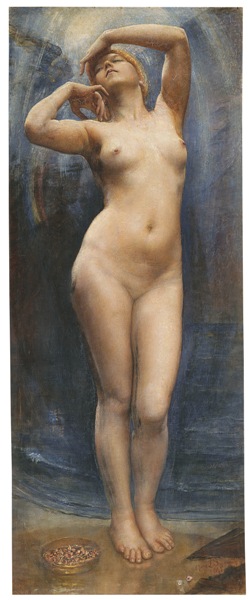 |
Musée d'Orsay, Paris Mater Triumphalis by Annie Louisa Swynnerton ,1892 |
'I will show Your Illustrious Lordship what a woman can do,' wrote the 17th-century Italian painter Artemisia Gentileschi to one of her patrons. This defiant declaration sums up the epic struggle of women artists down the ages to gain due recognition for their work and status.
Pittura was traditionally depicted as a female figure and it was in this guise that Artemisia presented herself in her 'Self-portrait as the Allegory of Painting' (La Pittura), which she made in the late 1630s while assisting her father, Orazio, who was serving as artist at Charles I's court. This, one of her finest works, is now in the Royal Collection.
In Britain, it was to be nearly a century and a half before another foreign artist, Angelica Kauffman, had the opportunity so publicly to celebrate artistic endeavour in the female form. In 1768 the Swiss-born Kauffman was, along with Mary Moser, one of two women among the 36 founding members of the Royal Academy. In 1778 she received the accolade of being commissioned, to provide for the Academy's new home at Somerset House four symbolic roundels representing elements of the creative process - 'Invention', 'Design', 'Composition' and 'Colour' - all of which she personified as women.
But the admission of Kauffman and Moser to the RA in London did not establish a precedent. Over a century later Ellen Clayton, author of English 'Female Painters' (1876) lamented that the RA had 'studiously ignored the existence of female artists, leaving them to work in the cold shade of utter neglect.' As Clayton discovered, some 900 women exhibited in public exhibitions in London between 1760 and 1830, but works by very few of them can now be identified.
Artemisia Gentileschi's 'Self-Portrait' and her 'Susanna and the Elders' (also in the Royal Collection and recently restored and identified as one of her works); a 'Self-portrait' by Kauffman, palette and brushes in hand, and several other of her works provide a suitable introduction to 'Now You See Us: Women Artists in Britain: 1520-1920' at Tate Britain. This absorbing exhibition, featuring over 100 artists, is stylishly curated by Tabitha Barber and Tim Batchelor.
Tabitha Barber, who is also the editor of the attractive catalogue, points out that while women were included in accounts of artists in the 17th and 18th centuries, ironically, with the advent of art history as an academic and university subject, they seem increasingly to have been written out of the story. This state of affairs was exacerbated by subsequent misattributions of pictures by women to their male contemporaries, a problem that stretches back to the earliest recorded female artists.
Several women miniaturists were active at the Tudor court, including Susanna Horenbout and Levina Teerlinc. Dürer admired and bought a work by Horenbout in 1521, but later her miniatures were frequently attributed variously to her brother Lucas and to Holbein. 'An Elizabethan Maunday Ceremony' (c.1560) by Teerlinc has inscribed on its metal frame of a later date: 'N. Hilliard'.
Another factor in obscuring the role of women artists has been the disappearance of their works. We currently have only one known picture, for example, an impressive self-portrait, by the 18th-century painter Mary Grace (d.1799/1801), despite her successful and well-paid career.
We have been more fortunate with Mary Beale (1633-1699), perhaps the best known and most productive female artist of the period. She ran a highly successful commercial London studio, managed by her husband and assisted by her children. She was a friend of Charles II's court portraitist Peter Lely and her 'Anne Sotheby' (recently acquired by the Tate), inspired by the former's portrait of 'Lady Essex Finch', shows in technique she was a scarcely less accomplished an artist than the Dutch portraitist.
But for many women artists obtaining commensurate remuneration for their labours was impossible. The only known oil painting by Mary Black (1737-1814) is a superb portrait of the physician Messenger Monsey. While he admitted its high quality, when she sought a modest payment for it Monsey was outraged, saying he was 'sorry to find Miss Black is grown so saucy, as it will only embarrass, or stop the progress of her reputation and improvement,' subsequently referring to her as a 'slut'. Fortunately, her more generous private students, to whom she later taught drawing and pastels, were more appreciative of her talents.
The Scottish artist Katherine Read (1723-1778), who was expertly trained in Paris and Rome fared a great deal better, despite lamenting that her 'unlucky sex' excluded her from picture collections, life classes and mixing with other artists in taverns. However, by the time she left Rome, the secretary to the exiled James Francis Edward Stuart, the 'Old Pretender', said of her, 'there never was anybody either Scots or English ever came near her in portrait painting.' When Read returned to London she set up a financially rewarding studio and exhibited in all the important shows, including at the RA. Nevertheless, many of her works were later attributed to male artists, among them Jean-Étienne Liotard, Reynolds and Anton Raphael Mengs.
After Angelica Kauffman left Britain for Rome in 1781, Maria Cosway (1760-1838) became 'the first of female painters' in London, exhibiting ambitious oils in various genres. She had been brought up in Florence and elected to the Academy of Fine Art there, but her husband refused to let her sell her works. She was the author of some truly remarkable pieces - such a portrait of 'Georgiana, Duchess of Devonshire, as Cynthia' in Spenser's poem 'The Faerie Queene' - but her originality attracted hostile accusations that they were the product of the 'weak dream of a sterile and fevered imagination'. Unfortunately most of her painted works are now lost and only known through engravings.
Later generations liked to mock the sentimentality of Victorian narrative pictures, but Emily Osborn's 'Nameless and Friendless' (1857), of a struggling young woman artist trying to interest a sceptical dealer in a canvas, while two louche men break off their ogling of a picture of a ballerina to eye her up, was a sadly accurate representation of the plight of many aspiring women artists at the time. Fortunately, Osborn was able to carve out a profitable artistic career for herself.
Despite the ever-increasing prominence of women artists in the late 19th and early 20th century, the RA remained obdurate when it came to admitting them as members. After exhibiting there for forty years Annie Louisa Swynnerton (1844-1933) was elected only an Associate Royal Academician in 1922, when she was nearly 80. Not until 1936 did a woman artist, Laura Knight, at last become a full RA, declaring of her predecessor that 'Mrs Swynnerton came and broke down the barriers of prejudice.'
Swynnerton - along with Henrietta Rae (1859-1928) and Anna Lea Merritt (1844-1930) - was prominent in the 1890s in challenging taboos when it came to women depicting the nude. Her 'Mater Triumphalis' (on loan from the Musée d'Orsay in Paris) caused a sensation. Another near-contemporary, Louise Jopling (1843-1933) had earlier raised eyebrows in 1875 with the mere bared shoulder of a model changing out of her studio finery in 'A Modern Cinderella'. Manchester-born but Paris-trained, Jopling was also active in feminist causes and started her own art school for women. The Tate has recently acquired her striking self-portrait, 'Through the Looking Glass' (1875).
The First World War brought unexpected opportunities for women artists to prove their mettle. Anna Airy (1882-1964), a brilliant draughtswoman, was the first official female war artist. Her five seven-by-six-foot canvases of munitions production, which included her 'Shop for Machining 15-inch Shells; Singer Manufacturing Company, Clydebank, Glasgow, 1918' were among the most memorable artistic records of the conflict. Even though she was barred from the front line, these commissions were hazardous and punishing undertakings. In an arms factory in Hackney she recalled standing on 'an earth floor black hot, that burnt a pair of shoes off my feet, the shell cases coming red-hot from the presses, in batches of 30 or 40, placed within 4ft of me & my very fingers dripping with perspiration.'
'Decoration: Excursion of Nausicaa' by Ethel Walker (1861-1951) was bought by the Tate in 1924 but she had to wait until 1940 to be elected an Associate of the RA. She wrote to the director of the Tate John Rothenstein suggesting he buy more of her canvases, since 'every purchase of my work strengthens and enriches the sum of good pictures at the Tate Gallery.'
There are many fine but unfamiliar works in this stimulating exhibition which are from private collections, and it can only be hoped that more of them will eventually be displayed permanently in public galleries so that these institutions can offer a more comprehensive and authentic picture of the contribution of women to Britain's art history.
Now You See Us: Women Artists in Britain 1520-1920, Tate Britain, 16 May - 13 October
First published: The Lady
© Roderick Conway Morris 1975-2026