 |
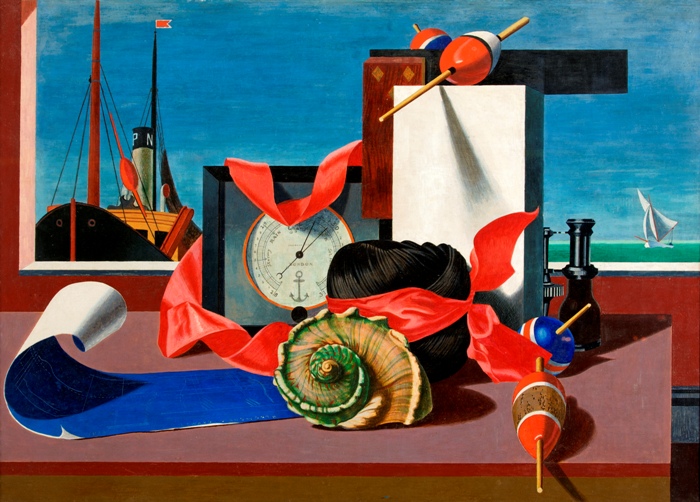 |
Museum & Art Swindon Bright Intervals by Edward Wadsworth, 1928 |
Enduring Images of the Everyday
| By Roderick Conway Morris | CHICHESTER 2 August 2024 |
According to Roman author Pliny the Elder, the ancient Greek artist Zeuxis of Heraclea painted a bunch of grapes so realistic that birds flew down to peck them. But the artist's rival Parrhasius then showed him a painting of a curtain, which Zeuxis demanded be drawn so he could examine the picture beneath. But the curtain was simply a brilliant trompe-l'oeil and Zeuxis had to admit 'that he had been surpassed, for that whereas he himself had only deceived the birds, Parrhasius had deceived him, an artist.'
Every genre - including still life, landscape, townscape, seascape and portraiture - dates back to antiquity and all were revived during the Renaissance thanks to the rediscovery of ancient art works and descriptions by classical authors.
The ambiguous status of still life in general and the trompe-l'oeil in particular, also dates back to antiquity. As Pliny records, the Hellenistic painter Piraikos, who confined himself to humble objects, such as foodstuffs, and subjects like barbers' and boot-makers' shops, was scorned by the elite, but his works fetched higher prices than those depicting more elevated historical and mythological themes.
Caravaggio (1571 -1610) was the first artist in the early modern era to declare 'that it cost him as much trouble to make a good flower picture as to make a figure painting'. He created his celebrated 'Basket of Fruit', now at the Biblioteca Ambrosiana in Milan, in the late 16th century. As Charles Sterling notes in his classic study, 'Still Life Painting from Antiquity to the Twentieth Century' (first published in 1952), Caravaggio's canvas 'marks the birth of the modern still life, definitively stripped of its religious and intellectual allusions and ranked on an equal footing with the human figure.' Intriguingly, given the often lowly reputation of this sub-genre, 'The Basket of Fruit' might well have been painted as a trompe-l'oeil.
Still life thrived in the 17th-century Golden Age of Dutch painting in the Protestant Netherlands, where explicitly religious subjects were rejected. But the beautifully executed images of exquisite glass and metal wares and sumptuous foods carried a spiritual message, celebrating the riches earned through the Dutch Republic's thriving foreign trade, while reminding the viewer of the transience of this earthly life. The point was often reinforced by worm holes in the fruit, wilting flowers, hour glasses and skulls. These came to be called Vanitas pictures after the exhortation in Ecclesiastes: 'Vanity of vanities, all is vanity.'
Britain's close ties with the Netherlands in the 17th and early 18th century brought the taste for the genre to these shores. This also led to the adoption of the term still life from the Dutch Still-leven, which literally meant 'motionless models', that is subjects that did not move, but in English fortuitously but appropriately took on a poetic flavour, suggesting calm and contemplation. The term in French and other Romance languages was nature morte or natura morta, which has a decidedly (and initially deliberately) denigratory ring to it.
How the genre fared in this country in the 20th and early 21st century is the subject of 'The Shape of Things: Still Life in Britain', a varied and engaging exhibition of over a hundred artists at Pallant House in Chichester, curated by a lively team of experts led by the gallery's director Simon Martin (who is also the editor of the attractive accompanying book).
In 18th-century France the prestige of still life was elevated by Jean-Siméon Chardin (1699-1779), the first native master to devote his prodigious talents primarily to this genre. But interest thereafter declined until it was revived by the Impressionists and their associates, notably Manet, Renoir, Monet, Vuillard and Bonnard, in the second half of the 19th century. The genre took on a new dimension in the hands of Cezanne through the extraordinary stylistic originality and expressive power of his canvases. So central was this art form to the Provençal painter's oeuvre that, as Charles Sterling notes, almost all of Cezanne's still lifes are finished pictures, while many of his landscapes and portraits remained incomplete.
Faced with the revolution in this field initiated by Cezanne and developed by Gauguin, Matisse and Van Gogh, British painters were both stimulated and sometimes no doubt intimidated by the challenge to emulate them. Among the most successful to take up the gauntlet were the Scottish Colourists, Samuel Peploe, John Duncan Fergusson, Francis Cadell and George Leslie Hunter, all of whom spent time in France before the First World War.
As has happened repeatedly in the history of still life, individual artists have have looked back to earlier, sometimes distant, eras for inspiration. William Nicholson (1872 - 1949) revisited the Dutch Golden Age in his 'Silver Casket and Red Leather Box' (1920). The casket itself is the work of the 18th-century English silversmith Hester Bateman. Nicholson, like the Dutch, often delighted in depicting luxurious glass and silverware and adding intriguing reflections, in this case of a tall window.
His onetime student Nina Hamnett, preferring everyday objects, was more drawn to the Cubist works of Braque - three-quarters of whose pieces are still lifes - and Picasso. As the Spanish Cubist Juan Gris joked, in the guitar Braque had found a new Madonna.
William Nicholson's son Ben was unquestionably influenced by the Cubists and Mondrian in his move towards abstraction. However, as he records, it was his father who introduced him to still life and provided the props: 'In my work, this theme did not originally come from Cubism but from my father - not only what he did as a painter but from the very beautiful striped and spotted jugs and mugs and goblets, and octagonal and hexagonal glass objects which he collected.'
In an article in 'The Listener' in 1931 Paul Nash, who had created a series of exquisite still-life wood engravings in the 1920s, wrote: 'The tyrannical reign of Nature Morte is, at last, over. Apples have had their day.' Nash's disdainful use of the French term and his mention of apples clearly indicated his hostility to the excessive influence of Cezanne, yet he made it clear that he nonetheless admired the work of Ben Nicholson.
One of Nash's most brilliant students at the Royal College of Art was Eric Ravilious, who had a life-long fascination with the hidden charms of commonplace objects, which he transformed into highly individualistic wood engravings and watercolour still lifes, such as 'Kettle, Teapot, Breadboard, Matches' (1939).
Proving that the genre was able to adjust to changing times, the inventor of Metaphysical painting, the Greek-Italian Giorgio de Chirico - through the use of odd juxtapositions of sometimes surprising objects such as single gloves, maps, confectionery, tailor's dummies and classical sculptures set against dreamlike backdrops of deserted townscapes - created from 1910 onwards still lifes evocative of the subconscious and disturbed states of mind.
After the First World War, this style of art became a full-blown international movement with the advent of Surrealism, which was the subject of two major exhibitions in London in the mid 1930s. Two striking works in this mode on show here are Edward Wadsworth's 'Bright Intervals' (1928) and Meredith Frampton's 'Trial and Error' (1939).
During the dark days of the Second World War two British artists struck a surprisingly optimistic note: Ivon Hitchens in his cheerfully exuberant 'Flowers' (1943) and Ben Nicholson with his '1943-45 (St, Ives, Cornwall)' of homely tea mugs and tiny union flag against a backdrop of a tranquil harbour view.
Post-war artists have continued fruitfully to renew and emulate still-life traditions from the past while giving them a contemporary twist. Tristam Hillier's 'The Green Bottle' (1950) depicts artfully illuminated objects and transparency with impressive skill against a dark background in the manner of the Dutch masters, while introducing an elusive surreal atmosphere.
Patrick Caulfield, for his assemblages, drew on varied sources, from Dutch still lifes and Cubism to commercial sign painting and advertizing images. In his 'Coloured Still Life' (1967) he presents a radically simplified, minimalist take on historical still lifes.
Renewed interest in the trompe-l'oeil is reflected in recent works by two contemporary artists. The Scottish Alison Watt started her career as a portrait and figure painter but became fascinated by the details in the canvases of the 18th-century portraitist Allan Ramsay. Her piece 'Weymiss' (2020) is a stunningly deceptive image of a pressed and unfolded kerchief with delicate lace borders. Watt has described such still lifes as nonetheless remaining closely related to human subjects, describing them as 'a portrait without a likeness.'
Poppy Jones, who lives and works in Bexhill-on-Sea in Sussex, achieves remarkable, subtle effects with oil and watercolour based on photographic images printed onto cotton, silk and suede. The palette of her dream-like 'Water Glass & Thistle' (2024), with its luminous, perfectly rendered half-filled glass and spikey thistle bathed in wintery light, takes on the appearance of an old, slightly creased sepia photograph.
The Shape of Things: Still Life in Britain, Pallant House, Chichester, 11 May - 20 October 2024
First published: The Lady
© Roderick Conway Morris 1975-2026