 |
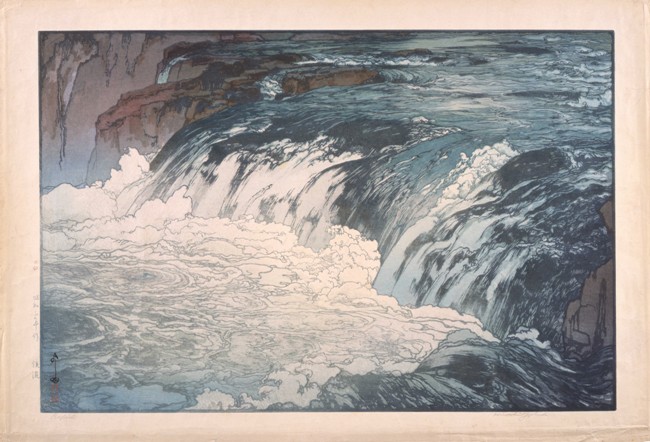 |
Fukuoka Art Museum, Japan Rapids by Hiroshi Yoshida,1928 |
The Royal Family of Japanese Prints
| By Roderick Conway Morris | LONDON 6 September 2024 |
In the spring of 1900, Hiroshi Yoshida a twenty-three year old Japanese artist, came to London along with another young painter Hachiro Nakagawa, to immerse themselves in the capital's great art collections. Their plans to visit the Dulwich Picture Gallery were thwarted, firstly when a policeman at Victoria Station assured them that no such place existed. A second attempt was equally fruitless, but on the third they succeeded.
The visitors' book signed by Yoshida and Nakagawa on 29 May 1900 opens a fascinating exhibition, 'Yoshida: Three Generations of Japanese Print Making' at the Dulwich Picture Gallery, curated by Monika Hinkel, who is also the author of the excellent accompanying book. For this then unknown Japanese visitor to the Gallery went on not only to win international fame for himself, but also to found a dynasty of artist-print makers, comprising his wife Fujio, his sons Toshi and Hodaka, his daughter-in-law Chizuko and his granddaughter Ayomi, who at the age of sixty-six is also a successful artist. This is the first retrospective of the family's superlative works in the UK and Europe, largely thanks to the extraordinarily generous loans of numerous pieces from the Fukuoka Art Museum.
Hiroshi was born in 1876 in Kurume City, in the prefecture of Fukuoka, on the southern island of Kyushu. By this time the heyday of the ukiyo-e, or Floating World print, perfected by the geniuses Hokusai and Hiroshige in the late 18th and first half of 19th centuries had passed. And the art form, in the words of Toshi Yoshida, was 'over-ripe in technical skill but quite impoverished in artistic value.'
After the Meiji Restoration of 1868, the end of the era of the Shoguns, Japan was being rapidly Westernized. Accordingly, Hiroshi began to study yoga, or Western-style painting, with Kasuburo Yoshida in 1891. His teacher had four daughters and, since women could not legally own businesses, he adopted Hiroshi, his most talented student, to run the painting workshop in due course. At this point Hiroshi took the Yoshida family name. His master died in 1894, by which time Hiroshi was continuing his training in Tokyo, where he was to remain based for the rest of his life.
An American collector had bought one of his watercolours in Japan and invited him to Detroit. Hiroshi set off for America with his friend Hachiro in 1899. The collector turned out be away on an extended trip, but the director of the Detroit Museum of Art arranged an exhibition of the young artists. Both sold well and other shows followed in Boston, Rhode Island and Washington. Their earnings financed their trip to England and then onwards to a tour of Europe. The experience gave Hiroshi a life-long passion for travel, which was inherited by all the succeeding generations of the Yoshida clan and reflected in the astonishing geographical spread of their subject matter.
In 1903 Hiroshi departed on another extended tour of America, Europe and North Africa with the sixteen-year-old artist daughter of his adoptive father, Fujio, who became the first Japanese woman painter to exhibit in America. The couple married when they returned home in 1907. Fujio would go on to make a notable career, especially celebrated for her prints of flowers. Among her unusual techniques was to magnify them by placing them in fish bowls.
Hiroshi did not come to woodblock printmaking until 1920, at the age of 44. Many were based on his earlier paintings but others on new designs. Unlike his historic predecessors, he insisted on cutting his own blocks (a task previously assigned to craftsmen) personally carrying out ever stage of the production. Whereas the images of the Floating World masters were created with between 10 and 20 blocks for different colours, Hiroshi's could involve 50 or more. He also vastly increased the colour ranges and nuances, such as extremely subtle shadings and shadows.
Despite the intensity of the labour involved, by the time of his death in 1950, he had executed around 259 such works. And, as the art critic Koichi Yasunaga has observed, Hiroshi's prints 'opened up a new frontier in Japan that was unprecedented and thoroughly original to him'.
Hiroshi and Fujio's first son Toshi was born in Tokyo in 1911. Having contracted polio he was unable to go to school but was encouraged to sketch birds and animals at home, both themes he constantly returned to thereafter. At fourteen he joined the family workshop, learned woodblock printing and assisted Hiroshi. Like him he studied Western-style painting. From early on he travelled widely with his father and further afield to Canada, Mexico and Africa. His 'Tokyo at Night series' (1938) demonstrates that he had entirely mastered his father's printmaking skills, and his love of challenging nocturnal scenes.
But unlike Hiroshi he became interested in abstract art, of which Hiroshi disapproved. A stimulus towards this were his pictures of underwater subjects of close-up views of fish and corals, of which he recorded: 'From these paintings, it was an easy - I suppose inevitable - step to abstraction'. Among his most striking images might be described as semi-abstract, such as his striking image of ducks swimming in a canal under willows, 'Bruges' (1955). But even his more abstract prints, of which he made almost 300 between 1952 and 1975, typically contain a figurative element, such as those inspired by majestic American rock formations, which also evoke Tokyo skyscrapers. He produced some of his most memorable figurative prints, such as of 'Santa Fé' and 'San Francisco', during the last decades of his life before this death in 1995.
Toshi's brother Hodaka was born in 1926, fifteen years after his brother. Hiroshi, a keen mountaineer, named him after his favourite peak in the Japanese Alps. As Toshi was the designated heir to the Yoshida studio, their father hoped that Hodaka might become a scientist. But he decided on art and was self-taught in painting oils. Hiroshi was shocked when Hodaka. exhibited abstract works in 1945.
He also started to experiment with woodblock prints, but did not show any until after his father's death in 1950. Originally he became better known as a photographer, but over 45 years he made some 130 oils and 600 prints. His bold Pop Art images, such as 'Nonsense Mythology', produced in the 60s and early '70s are often intriguing expressions of contemporary Western mass culture seen through Japanese eyes. He shared the family adeptness at employing and developing difficult printing techniques, constantly exploring new possibilities. In the late '70s he used combined photomontages, woodblocks and zinc plates to create strange, dream-like American scenes of figures and buildings. Other elements in them refer back to classic ukiyo-e elements, such as black outlines and colour fades at the top of the picture.
In 1953, Hodaka married Chizuko, a fellow artist from a family of art collectors in Yokohama, who had studied oil and watercolour painting and woodblock printing. She was clearly not intimidated by joining what was by now an august artistic dynasty. As Maribeth Graybill, an American writer on Japanese women artists writes: 'Working in the family atelier side-by-side with her husband and in-laws, Chizuko's competitive spirit spurred her to experiment with a wide variety of styles and techniques, from Abstract Expressionism to Op Art to closely observed studies of nature and landscapes'.
Chizuko and Hodaka's daughter Ayomi was born in 1958 in Tokyo, where she still lives. Her parents did not pressure her to draw or paint. She originally studied architecture, so she was entirely self-taught as an artist. When she was twenty-three she made her first woodblock print, which won a prize. She was surprised by her grandmother's Fujio's delight at this. At thirty Ayomi gave up her job in an architectural design studio to concentrate on projects that sought, as she put it, 'to fuse architectural structures - which I always wanted to create - and my family's tradition.' She made her first room-sized installation as a tribute to her father in 1996, after his sudden death the year before. She has proved a skilful and expressive wood carver both for relief sculptural effects and prints.
Ayomi has made a charming installation, 'Cherry Blossom', for the last room of the exhibition, with floor-to-ceiling engraved and painted panels, for which the roof has been opened up to admit natural light. The work is inspired by the cherry trees of Dulwich Village, which are descended from those of Yoshino, near the ancient Buddhist pilgrimage site at Nara. These trees are famed for their beauty and delicate scent and Yoshino is a favourite spot for hanami, or cherry-blossom viewing. On one wall are 10,000 hand-painted paper cherry-blossoms and facing it an image of spring rain, evoking the works of the great Hiroshige, known as 'the master of rain'.
Yoshida: Three Generations of Japanese Print Making, Dulwich Picture Gallery, 19 June - 3 November 2024
First published: The Lady
© Roderick Conway Morris 1975-2026