 |
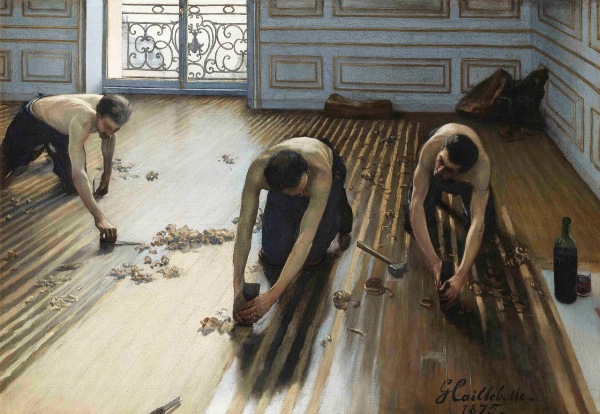 |
Musée d'Orsay, Paris/photo Patrice Shmidt Planing the Floor by Gustave Caillebotte, 1875 |
Unsung Hero of Impressionism
| By Roderick Conway Morris | PARIS 6 December 2024 |
Gustave Caillebotte played a unique role in the story of Impressionism. Not only did he display his own highly original work at the Impressionist group exhibitions but he bankrolled the movement, financing both its shows and individual artists. He also formed the most important contemporary collection of Impressionist work, which was left to the French state upon his untimely death at the age of 45 in 1894.
The Caillebotte Legacy sparked a furious controversy, which was dubbed the 'Affaire Caillebotte', since traditionalists vocally campaigned to persuade the government to reject it., But when finally, in 1897, 38 of the pictures - to which his executors, his brother Martial and Auguste Renoir, added Caillebotte's own 'Planing the Floor' and 'Rooftops (Snow)' - were displayed at the Musée de Luxembourg in a special gallery, this was the first one to be devoted to the movement and played a vital role in establishing the status of Impressionism in France and beyond.
Thirty years on from the first major retrospective of the artist held in Paris and then the US on the centenary of his death, the most extensive exhibition ever of his work, entitled 'Caillebotte: Painter of Men', is now being held at the Musée d'Orsay (and will travel on to the Getty in LA and Art Institute in Chicago). The show, of nearly 150 of his canvases and drawings, is stylishly curated by Scott Allan, Gloria Groom and Paul Perrin. The event is also the occasion for a welcome reassembling of the Caillebotte Legacy (the pictures of which are normally scattered through various rooms in the museum) in a single space in the Impressionist galleries there.
Caillebotte decreed that all his personal papers and letters be destroyed after his death. This has left much of his biography obscure, but thanks to the assiduous detective work, in public and private archives, a clearer picture of his personal life has gradually become available. Recent researches have, for example, revealed the existence of a female partner, Charlotte Berthier, who lived discreetly with the artist for many years.
Caillebotte was born in 1848 into a conservative Catholic family. His father had made a fortune supplying the French army with beds. Gustave had an older half-brother, Alfred, who became a priest and two younger brothers, René and Martial. Gustave graduated in law at 22 and served in the Seine Garde Mobile in the Franco-Prussian War (1870-71). He passed the entrance exam to the École des Beaux-Arts in the spring of 1873. After the death of his father in 1874, brother René two years later and mother in 1878, Gustave and Martial sold the family townhouse and a vast country estate near Paris and moved into a large apartment on Boulevard Haussmann, a fashionable address in the 9th arrondissement. Thanks to their property portfolios and investments the brothers were now wealthy, leaving Gustave free to pursue his artistic career and Martial his musical studies and photography.
In 1874 Caillebotte was working on 'Planing the Floor', an ambitious and unusual oil, of workmen, on their knees and stripped to the waist, finishing off the floor of the studio his father had financed. In that same year Degas invited Caillebotte to join him and others at the First Impressionist Exhibition but he declined.
After 'Planing the Floor' was rejected by the Salon in 1875 - after which he never submitted a picture to this institution again - he agreed to join the Second Impressionist Exhibition the following year. Some critics declared the artist's Planing the Floor, 'vulgar' but another praised its 'simple intimacy and frankness' and declared the picture 'primus inter pares'. Several advanced the suggestion that the artist was 'an Impressionist in name only.' Yet another predicted he would soon return to the academic fold, where 'the camp of real artists would kill the fatted calf to celebrate the return of the prodigal son.'
Instead, the twenty-eight-year-old newcomer threw himself into the organization of the Third Impressionist Exhibition in 1877, paying for the venue and consulting with the contributing artists to choose their best canvases. He rented a studio for Monet and encouraged him to do a series of paintings of the Saint-Lazare railway station. Caillebotte himself was occupied with his 'Pont de l'Europe', a scene on the new iron bridge which could be dimly discerned through the rising steam, spanning the tracks, in Monet's Saint-Lazare Station images, three of which Caillebotte bought. Meanwhile, the latter also produced another enormous canvas, with a dramatic perspective of the nearby Carrefour de Moscou (now place de Dublin), 'Paris Street: Rainy Weather'.
Thereafter, Caillebotte became the mainstay and financial underwriter of the Impressionist enterprise. As one critic of the Fourth Impressionist Exhibition 1879 put it, while Édouard Manet had launched the vessel containing his disciples into the open sea, 'it is M. Caillebotte who has taken a firm grip on the rudder of the boat, which without him would perhaps have drifted off-course' - a nice metaphor considering that Caillebotte, who was introduced to boating by Sisley, had been a founder of 'Le Yacht' magazine a year earlier.
The artist's engagement with practicalities is vividly witnessed by another critic, in Gaston Vassy's description of 'the truly extraordinary activity displayed by M. Caillebotte,' on the eve of the opening of the Seventh Impressionist Exhibition in 1882: 'M. Caillebotte comes and goes, giving orders, supervising the hanging of the canvases, working like a factotum, just as if he didn't have an income of 50,000 francs in rents.'
Caillebotte was also unique among his fellow Impressionists in that his subjects are overwhelmingly male, both working class and bourgeois. He painted many portraits of his friends in both categories. His intimates included scholars, lawyers, bankers and businessmen, a number of whom collected his pictures, as well as sailors and watermen, who shared his activities as a rower, yachtsman, boat designer and builder. One of his rare self portraits, in which he is dressed in sailor's attire, was a gift to a mariner, Joseph Kerbrat, whom he lodged at his Petit-Gennevilliers estate on the banks of the Seine, where he settled in the early 1880s. Caillebotte deplored Degas' snobbish attitude towards Monet and Pissarro, whom Degas regarded as his social inferiors.
Despite his apparent bachelor existence, it now emerges that Caillebotte long cohabited with one Charlotte Berthier, née Anne-Marie Hagen. That she adopted a pseudonym suggests she might well have been an actress. His 'Interior (Woman Reading)' is almost certainly of her, as is another back-view of a woman at a window. In both cases male friends are also depicted, indicating that she was no secret to his circle of intimates. Amusingly, her presence is sometimes suggested in a coded fashion by the appearance of her dog Bergère, as in a photograph of the artist taken by his brother Martial in a misty Place du Carrousel. After Martial married in 1887, his wife refused to receive Charlotte, although the brothers remained close. Upon his death the artist left her a house and an annuity. After which, she moved to Monte Carlo.
Having invested a vast amount of time and energy, not to mention emotional and diplomatic capital, in guiding the often fractious ark of Impressionism, Caillebottte was clearly disappointed when some members of the group - Sisley, Renoir and Monet among them - began to desert their exhibitions in favour of the Salon. However, he wrote sympathetically to Monet, acknowledging the difference in their circumstances.
Caillebotte himself last exhibited with the group at the Seventh Impressionist Exhibition in 1882 (there was to be a final one four years later). He demonstrated there that he had lost none of his daring, two of his canvases, 'Traffic Island' and 'Boulevard Seen from Above', being unprecedented, vertiginous aerial street views. Now spending more time at his house at Petit-Gennevilliers on the Seine, his subject matter switched increasingly to boating, river views and landscapes. A serious horticulturalist, cultivating decorative, exotic and kitchen garden plants, he also recorded these activities in paint. One of the most charming of these scenes, 'The Roses: Garden at Petit-Gennevilliers', depicts both Charlotte Berthier and her dog Bergère.
Ironically, Caillebotte's posthumous reputation as an artist suffered from his famous donation of the collection of Impressionists named after him. His other activities as a yachtsman, horticulturalist and stamp collector (he and Martial were later hailed in Britain as 'fathers of philately') also tended to his being misrepresented as an amateur painter, 'a millionaire who paints in his idle moments'. As the critic Gustave Geffroy opined: 'If he had been forced to struggle to make a living, he would have been more driven and would have been rated more highly in the art of his times.'
But as this exemplary exhibition demonstrates, Gustave Caillebotte was as significant a painter as he was an exceptionally generous patron and discriminating collector.
Caillebotte: Painter of Men at the Musée d'Orsay, Paris, 8 October 2024 - 9 January 2025; J. Paul Getty Museum, Los Angeles, 28 February - 25 May 2025; Art Institute of Chicago, 22 June - 5 October 2025
First published: The Lady
© Roderick Conway Morris 1975-2026