 |
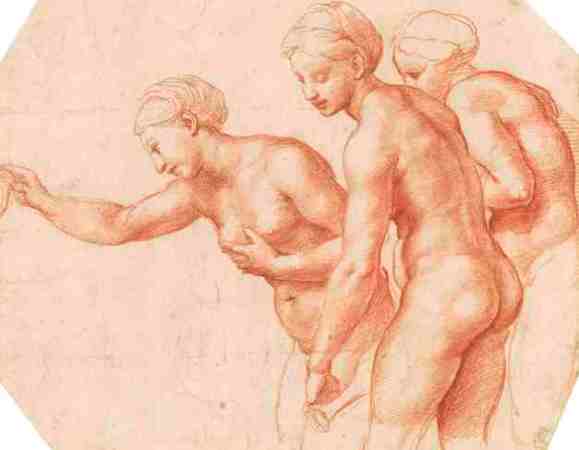 |
Royal Collection Enterprises Limited 2024 The Three Graces by Raphael, 1517-18 |
A Good Year for Renaissance Men
| By Roderick Conway Morris | LONDON 3 January 2025 |
On 4th September 1504, Michelangelo's immense statue of 'David' was trundled out of the stone-cutting yard next to Florence's Duomo to begin its journey to the nearby Piazza della Signoria, the city's central square. 'It went very slowly,' wrote the diarist Luca Landucci, 'being bound in an upright position, and suspended so that it did not touch the ground with its feet. There were immensely strong beams, constructed with great skill; and it took four days to reach the Piazza.'
The positioning of this colossus at the heart of city was just one of a series of symbolic acts designed to celebrate the re-birth of the Florentine Republic following the death of Lorenzo the Magnificent in 1492 and the expulsion of the Medici, who had long ruled as virtual dictators.
Michelangelo had returned in 1501 to begin work on 'David'. Leonardo da Vinci, who had been absent for two decades in the service of Ludovico 'Il Moro' Sforza, Duke of Milan, also came back, in 1503. He was commissioned to adorn with a large mural the newly built Great Council Chamber behind the Palazzo della Signoria, now once again the seat of republican government. The subject was to be the 'Battle of Anghiari', a famous Florentine victory over Milan in 1440. In the summer of 1504, the state commissioned Michelangelo to depict the 'Battle of Cascina', fought against the Pisans in 1364, also for the Great Council Chamber. Thus two of Florence's artistic titans were pitted against each other in the republic's most prestigious public space.
Into this arena stepped the young Raphael, newly arrived from Urbino in the autumn of 1504, an observer rather than protagonist who was to spend much of the next four years in the city honing his skills before his permanent move to Rome.
This brief period is now the subject of an absorbing exhibition, 'Michelangelo, Leonardo, Raphael: Florence, c. 1504', curated by Scott Nethersole and Per Rumberg, at the Royal Academy. Key exhibits include Michelangelo's 'Virgin and Child' ('The Taddei Tondo') one of the RA's own treasures, and Leonardo's 'Virgin and Child', dubbed the 'Burlington House Cartoon' by Kenneth Clark in 1939, when it was still in the RA's collection there, before its sale to the National Gallery in 1962. From further afield are Piero di Cosimo's tondo of 'Virgin and Child' from Strasbourg; and Raphael's 'Bridgewater Madonna' from Edinburgh and 'Esterházy Madonna' from Budapest. This is also the occasion for an exceptional gathering of rare drawings by the three masters of the show's title from a score of collections.
Leonardo was over 50 when he returned to Florence and Michelangelo in his mid twenties. Raphael was just 21. The 16th-century Florentine father of art history Giorgio Vasari recorded in his 'Lives of the Artists' that relations between Michelangelo and Leonardo were marked by thorough contempt (sdegno grandissimo) 'owing to their rivalry'. The young Raphael, famous for his charm, grace and diplomacy, seems to have successfully navigated this hostility, managing to have cordial relations with both more senior artists.
Leonardo, whose interests were infinitely wider than Michelangelo's, was notorious for failing to complete projects, but the latter was not without sin in this department. Michelangelo publicly ridiculed his rival for failing to complete the gigantic bronze horse that he had been making for Ludovico Sforza, Duke of Milan. But he himself, having been commissioned in 1503 by the prosperous Arte della Lana (Wool Guild) to do statues of the twelve apostles for the Duomo, only ever completed one of them, 'St Matthew'. His 'Taddei Tondo' is equally notable for its unfinished state.
Whether the 'Burlington Madonna', one of the most stupendous of Leonardo's works to come down to us, is complete or not is a moot point. Vasari describes the artist displaying such a cartoon of the 'Virgin and Child with St Anne' in the church of the Santissima Annunziata where 'men and women, young and old, continued for two days to flock for a sight of it to the room where it was, as if to a solemn festival, in order to gaze at the marvels of Leonardo, which caused all those people to be amazed.' Whether this was the 'Burlington Cartoon' is not certain, but the paper in the design was not pricked, so it was never transferred to a wall and by the artist's standards it is an extraordinarily 'finished' drawing, possibly for presentation purposes. And its effect can be almost as powerful on viewers today as that of the cartoon displayed in Florence over 500 years ago.
In failing to deliver major projects, Leonardo and Michelangelo equally shared the laurels when it came to the much-anticipated scenes for the Grand Council Chamber. Leonardo's surviving preparatory drawings for the 'Battle of Anghiari' show a frenetic mêlée of horses and warriors, lances, flashing swords and scimitars. Michelangelo's for the 'Battle of Cascina' avoids depicting the clash altogether, but instead turns into a celebration of the male nude in multiple poses as the Florentine soldiers, who have been cooling off in a river, hurriedly rush to attire and arm themselves as the call to arms is sounded.
The juxtaposition of their drawings offer a brilliant compare-and-contrast display of the artists' respective styles. Around 2,500 drawings by Leonardo have been preserved, but some of those here are among the most lively and dynamic. Michelangelo famously destroyed almost all his preparatory drawings before his death - perhaps to encourage the legend of his own perfection - so these detailed sketches of the male figure are an especially valuable record of his working methods.
Leonardo began painting his mural in the Grand Council Chamber in the summer of 1505, but using an experimental technique that led to its rapid deterioration. Thereafter he spent little time in Florence, soon departing for Milan, then France. Michelangelo's cartoon was never even transferred to the wall before the Pope's demands took him away to Rome. Ironically, it was the primary chronicler of this Florentine artistic drama, Giorgio Vasari, who eventually painted new frescoes over what was left of Leonardo's mural between 1555 and 1572.
Nonetheless, numerous artists, Raphael among the first, would subsequently have access to Leonardo's and Michelangelo's mythical preparatory drawings and cartoons, which had an enormous influence in the years that followed. Marcantonio Raimondini's 'Climbers', a freely interpreted print of a detail of Michelangelo's riverside scene, was made as early as 1510. Bastiano da Sangallo's grisaille oil was done in around 1542, and an anonymous drawing of Leonardo's mural, later owned and re-worked by Rubens, date to the 1550s.
Michelangelo had almost no interest in the female nude and his rare attempts to depict the feminine form were unconvincing. Raphael, on the other hand, was probably the first artist to make female life studies directly from a studio model, rather than compose them on the basis of classical statuary. His beautiful 'Three Graces' from around 1517-18, a study for a fresco at Villa Farnesina in Rome, is one of the first works in a stunning exhibition, 'Drawing the Italian Renaissance', at the King's Gallery at Buckingham Palace.
This fascinating show of around 160 works by over 80 artists, more than 30 of which are being displayed for the first time, is curated by Martin Clayton. For conservation reasons, none of these pieces can be shown for long periods, so this is a rare opportunity to admire them. While Cromwell's wholesale disposal of Charles I's superb art collection deprived the nation of many precious works, Charles II fortunately did much to repair the losses.
The current Royal Collection has some 2,000 sheets of Italian Renaissance drawings but few were acquired after 1770. However, almost all the greats are represented, including Leonardo, Michelangelo, Titian, Veronese and the Carracci, as well as many lesser-known artists who produced outstanding works. Pencils and pads are also on hand for those visitors who feel inspired to copy or make their own creations.
Until the late 15th century, metalpoint was the most common form of drawing, using a stylus, usually of silver, on specially prepared paper - a wonderful example here being Fra Angelico's 'Bust of a Cleric' (c. 1447-50).
But the wider availability of cheaper paper stimulated an explosion throughout Italy of graphic activity, employing pencils, charcoal, chalks and pen and ink. Federico Barocci, who like Raphael was from Urbino, was a pioneer in the use of coloured chalks, producing such lovely pieces as his 'Head of a Virgin' (c. 1582), a preparatory drawing for an 'Annunciation' now at the Vatican.
While most of the pieces on show here are preparatory sketches, some were intended to be displayed. Hardly any drawings by the Venetian painter Giovanni Bellini survive, but his mesmerizing 'Head of an Old Man' (c. 1460-70) is clearly an example of one such work, in view of the pin holes in its corners and the traces of a layer of varnish.
Michelangelo, Leonardo, Raphael: Florence, c. 1504 at the Royal Academy, London, 9 November 2024 - 16 February 2025
Drawing the Italian Renaissance at the King's Gallery Buckingham Place, 1 November 2024 - 9 March 2025
First published: The Lady
© Roderick Conway Morris 1975-2026