 |
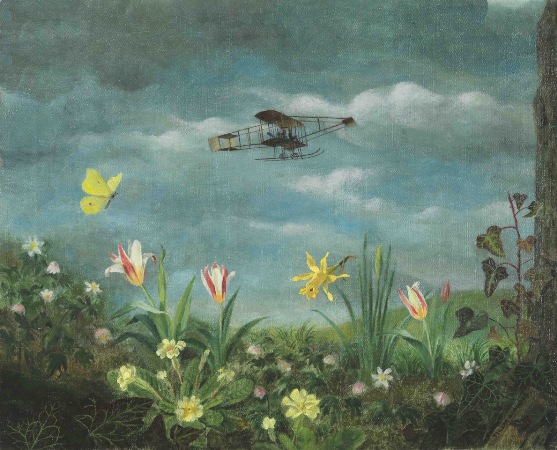 |
Private collection Springtime of Flight by Tirzah Garwood, 1950 |
Much more than Mrs Ravilious
| By Roderick Conway Morris | LONDON 7 March 2025 |
Tirzah Garwood earned some of her most perceptive plaudits only on the occasion of her Memorial Exhibition at the Art Council Gallery in June 1952, over year after her premature death just before her forty-third birthday. A critic on the BBC's Third Programme spoke of 'an exact talent multifariously deployed, at moments curiously arresting in its dreamlike quality of imagination'.
Since she never had a retrospective exhibition during her lifetime, that exhibition was the first opportunity to review her original and various output - wood engravings, drawings, prints, collage and oils. As 'The Times' critic then commented, it had been her fate to be remembered mainly as 'Mrs Eric Ravilious', having married the more famous artist in 1930.
Ravilious disappeared with a plane on an air-sea rescue mission off Iceland in September 1942 at the age of 39, while serving as a War Artist.
His work too fell into comparative obscurity in the intervening years. Nobody has done more to revive interest in it recently than James Russell, who curated a landmark exhibition of Ravilious's watercolours and lithographs at the Dulwich Picture Gallery a decade ago. The Gallery is now the venue for another revelatory event, Tirzah Garwood: Beyond Ravilious, a show of over 100 of her own and related works, accompanied by an attractive and informative catalogue.
Both Tirzah Garwood and Eric Ravilious studied at the Eastbourne College of Art on the East Sussex coast. Ravilious was five years her senior and by the time she became a full-time student at 17 in 1926 he had returned there to teach. While a postgraduate at the Royal College of Art in London, Ravilious had studied wood engraving under Paul Nash, who sponsored him as a member of the Society of Wood Engravers in 1925.
Garwood made such rapid progress in mastering wood engraving and her subject matter was so striking that Ravilious, who was by then on the committee of the Society of Wood Engravers, convinced them that her work was worthy of inclusion in their annual exhibition in 1929.
Tirzah was born in Gillingham in Kent in 1908, the third of five children, into a comfortably-off upper middle-class family. Her father was a Colonel in the Royal Engineers, her mother the daughter of Belfast ship builder. Christened Eileen Lucy, she acquired her lifelong nickname when her grandmother inquired after 'Tertia'. Her two elder siblings immediately converted this into Tirzah, an Old Testament name they had come across in their nightly scripture readings.
Eric Ravilious was the son of a working-class Eastbourne family who won a scholarship to the local grammar school and then another to the College of Art. As the two young artists became closer, neither family approved of their association and Tirzah admitted that she was at first disconcerted by Ravilious's 'unfamiliar and rather frightening working class world'. Tirzah's parents were both keen watercolourists and she learned botanical painting from her mother, but they were not sympathetic to modern trends or their daughter's desire to follow Ravilious to London, to which he had moved to pursue his artistic career.
However, the inclusion by the Society of Wood Engravers of her woodcuts in their annual show and praise from the critic of 'The Times', no less, was decisive. As Garwood later recalled: 'This more than anything convinced my parents that they ought to let me go, though they thought my subjects hideous and that Mr Ravilious was perverting a nice girl used to drawing fairies and flowers into a stranger who rounded on them and did drawings that were only too clearly caricatures of themselves.'
These words are from 'Long Live Great Bardfield: The Autobiography of Tirzah Garwood', a minor classic and one of the best and most entertaining memoirs ever produced by an artist.
She wrote them in 1942, while recovering from an emergency mastectomy, following a diagnosis of breast cancer. It was not intended for publication but for her family and descendants. Its unabashed candour, not least about Ravilious's and her own infidelities, her satirical eye and frank comments would have made it in any case impossible to print at the time. But Garwood's daughter Anne Ullman, an art historian, who later edited the manuscript, filling in some missing parts of the story with letters and other reminiscences, first published it in 2012.
After their marriage in 1930, the couple's partnership proved artistically mutually beneficial. They first lived in London, then partly in a house in Great Bardfield in Essex before moving permanently to Castle Headingham in the same county in 1934. Despite at first playing cards after lunch to decide who should clear away the plates, the burden of domestic duties fell heavily upon Tirzah - a situation, she observes in her memoirs, typical of other artistic couples they knew. This became even more so from 1935, when Tirzah gave birth to the first of three children.
Although in many ways the more accomplished wood engraver, Tirzah found herself assisting with Ravilious's woodcuts. When he received a commission for murals on seaside themes at the Midland Hotel in Morecombe, an adventure amusingly recounted in her autobiography, she remained uncredited for her contribution. Both she and Ravilious had a passion for Victoriana and Tirzah's antique childhood doll's house inspired part of his murals for Morley College. The paintings, alas, were destroyed in the Blitz.
Garwood's experiments with marbled papers, in which she displayed real genius, led her to set up a business with Charlotte Bawden, the wife of the artist Edward, in 1934. Their work became much in demand and two sets of papers were bought by the V&A in 1937. In the spring of 1934 the Raviliouses were invited to the artist Peggy Angus's cottage, Furlongs, in the South Downs. Garwood describes the scene: '...streams of friends came to Furlongs, sleeping in tents or on straw mattresses inside which Peggy had made for beds. I added to the general muddle by having my marbling tank on the copper in the tiny scullery but as I provided wallpaper, Peggy didn't mind.'
She also wrote that 'marbling gave me pleasure because I felt that no one else can do this.' The details of the 'new method' she discovered remain a mystery, but her productions have been compared to the finest works of the Ottoman masters of the craft.
While at Furlongs, Ravilious befriended the head gardener of a local estate, who allowed him the run of eight magnificent greenhouses, giving rise to one of his classic watercolours, 'The Greenhouse: Cyclamen and Tomatoes' (1935). The gardener related to him how he had once joined a plant-hunting expedition up the Amazon. Garwood re-imagined this theme not long before her death in her wonderful, Henri Rousseau-esque 'Orchid Hunters in Brazil' (1952).
Both artists created memorable vignettes of the interior of railway carriages with views of the passing countryside. Her wood engraving 'Train Journey' (1929) included a self-portrait in the righthand foreground. In 1939, Ravilious did two watercolours of empty compartments with different views. Dissatisfied he abandoned both, until Garwood took her scalpel to the one showing the chalk hillside outline of the Westbury Horse and collaged part of it into the other version, 'Train Journey', now one of his most celebrated works.
Garwood began to make collages during the war years, partly perhaps because of scarcity of art materials and to teach her young children about art. These productions became increasingly sophisticated and three dimensional, being set in the kind of glass cases that her father used to display his Indian butterflies collection.
In 1947 Garwood wrote in an article on collages: 'Except for a few primitive painters like Henri Rousseau, it is impossible to return to the Garden of Eden of unselfconscious work when you have eaten the apple of knowledge.' Yet in her collages and oils she succeeded in doing just that, in the last decade and a half of her life.
She began painting in oil shortly before the end of the war, and after her cancer returned and she became increasingly ill, eventually working on small canvases while propped up in bed. She seems to have been a natural surrealist, having a sharp eye for oddities and absurdities (as she richly reveals in her memoirs), but she never identified herself with the movement.
Given a gift of 'particularly beautiful little spring tulips with alternating pink marks on the backs of their petals and a miniature daffodil', she used them to make 'Springtime in Flight' (1950), a singular ground-up view of the sky across which float a butterfly and flying machine, taken from a pre-World War I postcard advertizing Eastbourne. She painted 20 of these intriguing paintings during her last days, this extraordinary burst of creativity leading her to describe her last year as 'the happiest of her life'.
'Tirzah Garwood: Beyond Ravilious' at the Dulwich Picture Gallery, 19 November 2024 - 26 May 2025
'Long Live Great Bardfield: The Autobiography of Tirzah Garwood', is published by Persephone Books, price £15
First published: International Herald Tribune
© Roderick Conway Morris 1975-2026