 |
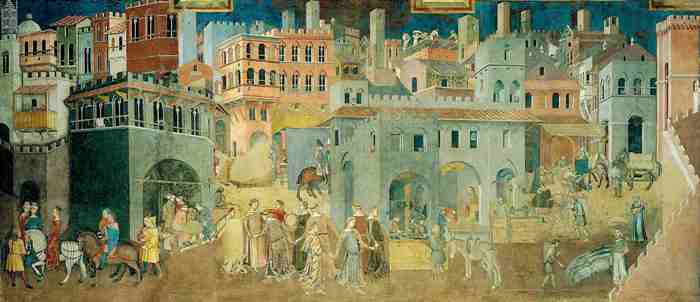 |
Palazzo Pubblico, Siena The Effects of Good Government fresco by Ambrogio Lorenzetti, 1338 |
Sowing the Seeds of the Renaissance
| By Roderick Conway Morris | LONDON 4 April 2025 |
On September 4 1260 the Sienese routed a vastly superior Florentine army sent to conquer the city at Montaperti, just outside Siena's walls. The night before, the mayor solemnly carried the keys of the city in procession to the Duomo to lay them below the icon of the Madonna on the high altar, making the town and all its lands over to her.
The next day, the Sienese army, seeing her white banner floating over them took heart for, in the words of a chronicler, 'it seemed the mantle of the Virgin Mary', was spread over them to protect them. In the battle that followed up to 10,000 Florentines and their allies died at the loss of only 600 Sienese. To this day, Sienese football fans chant 'Montaperti! Montaperti!' to annoy their Florentine rivals.
The victory at Montaperti was ever after credited to the intervention of the Virgin and the already fervent worship of her in Siena became even more intense, soon to act as a stimulus in the creation of a series of astonishingly innovative works of art.
But history, notoriously, is written by the victors - even art history. In 1561 Siena was finally conquered by Cosimo I de' Medici, Duke of Florence. In 1568 Giorgio Vasari published in Florence the definitive edition of his 'Lives of the Artists', the most influential art history book ever written. It was an extraordinary feat but its leitmotif was the superiority of all things Florentine in art.
An enthralling exhibition, 'Siena: The Rise of Painting 1300-1350', at the National Gallery triumphantly demonstrates Siena's predominant role during the proto-Renaissance period, both in developing the art of painting and in raising its status not only in Italy but throughout Europe. The show, over a decade in the making, is curated by Caroline Campbell, Joanna Cannon, Laura Llewelyn, Imogen Tedbury and Stephan Wolohojian, and even those with some knowledge of the subject will find it a revelation.
Italy's medieval city-state republics were riven with factional strife, alternating between various elected bodies and the dictatorial rule of assertive leading families. But in 1287 Siena finally devised a system of representative government, ruled over by the council of the Nine, that lasted until 1355. This was also the period when so many of the city's characteristic streets, palaces, churches, institutional buildings and fountains were constructed, and the imposing gothic Palazzo Pubblico, or city hall, rose up with its dizzying tower to dominate Siena's fan-shaped central piazza, the Campo. Reformed governance ushered in what came to be seen as a golden age of tranquillity, prosperity and artistic creativity. 'In that time', wrote Fra Filippo Agazzari, 'the city of Siena was in such great peace, and in such great abundance of every earthly good, that almost every feast day innumerable weddings of young women were celebrated in the city.'
Just such a festive scene was depicted in the foreground of Ambrogio Lorenzetti's wonderful frescoes of 'Good and Bad Government' (1338-39) in the Palazzo Pubblico, in which the stripy black-and-white campanile and the dome of Siena's Duomo can be discerned in the top left-hand corner.
Duccio di Buoninsegna (who is documented from 1278 and died in 1319) was the genius who presided over the transformation of painting in Siena. As early as 1285 he had been commissioned to make the 'Rucellai Madonna' for the Church of Santa Maria Novella in Florence. Vasari later attributed it to the Florentine Cimabue. Despite the discovery of the original contract in 1790, it was not until the 1930s that Duccio's authorship was restored to him. This was one of a number of egregious misattributions that severely skewed the true histories of Sienese and Florentine painting. For while Sienese painters were winning commissions in Florence, no Florentine painters are recorded as working in Siena.
Writing a century before Vasari, the renowned Florentine artist Lorenzo Ghiberti praised Siena's painters unreservedly, calling Duccio's work 'magnificent' and Ambrogio Lorenzetti 'the most famous and distinctive master, the most noble designer, learned as no other painter was.'
Duccio's supreme creation, his great altarpiece the 'Maestà', or 'Madonna and Child Enthroned in Majesty', was made for the Duomo. This gorgeous, exquisitely painted double-sided panel (its two faces were separated in 1771), is more than 14 feet wide and six feet high, and contains over 140 figures. The front face shows the Virgin and Child surrounded by a host of angels and saints, while the back relates in 26 individual scenes the entry of Christ into Jerusalem and his Passion.
The 'Maestà 'took just three years to complete (1308-11), and when it was carried in procession, amid the ringing of bells and general rejoicing, from the artist's studio to the Duomo, a contemporary witness declared it 'the most beautiful picture ever seen or made'. The artist inscribed on the plinth beneath the Virgin's feet in elegant Gothic script: 'Holy Mother of God, be Thou the cause of peace in Siena, be life to Duccio because he has painted Thee thus.' Altarpieces in side chapels were later added by the outstanding Sienese painters who followed Duccio, Simone Martini and the brothers Ambrogio and Pietro Lorenzetti, all of whom worked in the master's workshop.
While the central part of the 'Maestà' remains in Siena, other elements have been widely scattered between collections on both sides of the Atlantic. In a series of brilliant re-unifications, eight panels from the rear predella, or plinth of the altarpiece, depicting Christ's Ministry have been brought together from Siena, London, Madrid, Fort Worth, New York and Washington for the first time in almost 250 years. The National Gallery's own 'Triptych of the Virgin and Child with Saints' and its pendant 'Triptych of the Crucifixion' from Boston are also displayed together for the first time in centuries.
The dispersed components of Simone Martini's panels for the Palazzo Pubblico and his breathtaking 'Orsini Polyptych' (now divided between Antwerp, Berlin and Paris) are also reunited, as are Pietro Lorenzetti's 'Christ Before Pilate and Crucifixion' (1340s), now in the Vatican and New York.
Duccio succeeded in revolutionizing the treatment of Byzantine models that had till then largely inspired Italian art. He also absorbed lessons from Northern Gothic sculpture, primarily through superb miniature ivories from Paris, like the 'Quadriptych with Scenes of Christ's Passion' (c. 1300) on display here. He would certainly have seen what is now known as the 'Saint-Sulpice Triptych' (1296-1303), now in the Musée de Cluny, which was in Perugia when he was painting a polyptych there soon after 1304.
After Duccio died 1319, Simone Martini's studio, in which he collaborated with his brother Donato and brother-in-law Lippo Memmi, was considered locally the most outstanding. The Florentine Ghiberti praised their harmonies of line and colour, writing of them: 'they were gentle masters, and their pictures were done with the greatest diligence, most delicately finished.' They were also innovators, taking further inspiration from sculpture, and went on to become a primary source in the creation of the International Gothic Style.
Fleeing the anarchy of Rome, the Papacy transferred its seat to Avignon between 1309 and 1362, during the so-called 'Babylonian Captivity'. Martini moved there in 1333 and remained until his death a decade later. He was by no means the only Sienese painter in residence but became the most celebrated, the poet Petrarch writing two sonnets eulogizing him. He had numerous ecclesiastical commissions but was no less sought after by the likes of Philip the Bold, Duke of Burgundy, and Charles IV of Bohemia. Patronage by such temporal rulers spread the taste for Sienese painting and the International Gothic throughout northern and central Europe. Philip acquired Simone's 'Orsini Tryptych', which inspired entire pages of the sumptuous illuminations in the books he commissioned.
Four years after Simone Martini's demise in Avignon the Black Death arrived in Siena. Pietro and Ambrogio Lorenzetti, who had dominated the scene there since the departure of Simone di Martini, died along with Ambrogio's daughters and half the city's population. Siena was more badly affected than Florence and took longer to recover.
Nonetheless, continuing demand for paintings in the Sienese style led on this side of the channel to the creation of 'Richard II Presented to the Virgin and Child by his Patron St. John the Baptist and Saints Edward and Edmund', known as the 'Wilton Diptych' (1396-9), one of the National Gallery's greatest treasures. Multiple elements, from the materials employed and depiction of figures and, for example, the bright blue colour of the robes of the Virgin and angels, bear witness to its direct descent from Sienese models.
The 'Wilton Diptych' vividly shows that even two generations later and in a far-flung land the allure remained of those stupendous golden panels originally created, in Bernard Berenson's words, in 'soft Siena, then, as always, sorceress and queen among Italian cities'.
Siena: The Rise of Painting 1300-1350, National Gallery, London, 8 March - 22 June 2025
First published: The Lady
© Roderick Conway Morris 1975-2026