 |
100 Years of Art Deco
| By Roderick Conway Morris |
PARIS 20 February 2026 |
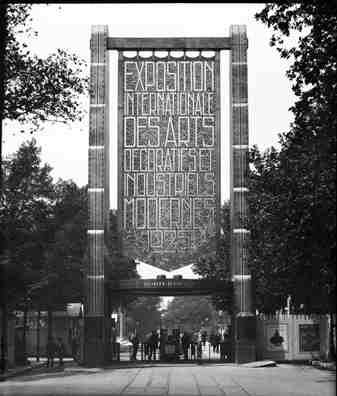 |
Les Arts Décoratifs Porte d'Orsay, 1925. Designed by the architect Louis-Hippolyte Boileau (1878–1948) |
A year after the outbreak of the Great War, René Guilleré (1878–1931) issued another call to arms: 'For centuries France imposed its taste on the world. Today, all we are able to do is glory in the talent that our ancestors had,' wrote this lawyer and champion of the decorative arts. 'We must act resolutely, pick ourselves up again. We have to reconnect with our traditions and remain creators. It is a primary duty for the Republic to assist in the realisation of modern styles.'
Guilleré had been one of the founders of the Société des artistes-décorateurs (SAD) in 1901 and a leading advocate for staging a large-scale international exhibition in the French capital, aimed first and foremost at stimulating and promoting French decorative arts. The matter became increasingly urgent in the face of burgeoning foreign competition in a field that the French had dominated for over 200 years. Germany was seen as a particular threat. The superior organization of a body like the Deutscher Werkbund, which brought together artists, artisans, architects and industrialists, and whose products were exhibited at SAD's Salon d'automne in Paris 1910, was positively alarming. Even British companies, such as Waring & Gillow, were now established in Paris. The model for the show was not to be Paris's Exposition Internationale of 1900 but The First International Exhibition of Modern Decorative Arts, held in Turin in 1902, now looked back upon as the high-point exhibition of Art Nouveau.
As discussions rumbled on, in 1909, Roger Marx (1888–1977), Inspector of the Museums of France, suggested that all the exhibits should be strictly modern 'except to the extent that they are rigorously adapted to the era in which they appear'. Plans were approved by the Chambre des Députés in 1912, with a target date for the event of 1915. This was postponed in 1914 to some uncertain future date, at which point the outbreak of war put the entire project on hold. And so it was not until the spring of 1925 that the 'Exposition internationale des arts décoratifs et industriels modernes' finally opened its doors.
To celebrate the centenary, the Musée des Arts Décoratifs has brought together over 1,200 exhibits, including furniture, sculptures, metalwork, glass, ceramics, textiles, printed matter and jewellery, many of them shown at the original exhibition and other relevant pieces from the years immediately preceding and following the event. The show is curated by a team of experts led by Anne Monier Vanryb, recently appointed Conservator of Collections 1910–1960 at the museum. Extensive visual documentation is provided in the exhibition and catalogue by contemporary graphics, photographs and films, including some of the 671 'autochrome' colour images from the archives of the Musée Albert-Khan at Boulogne-Billancourt.
While the core purpose remained the same, the event came also to be seen as a symbol of the rebirth of a nation. The 55-acre site, spanning the Seine and linked by the Pont Alexandre III was the same as that of the Exposition Universelle a quarter of a century before. But although the numerous pavilions were constructed in materials such as stone, concrete, brick and glass, they left no permanent legacy, in contrast with the previous show that had added the Grand and Petit Palais exhibition venues to the architecture of Paris.
French producers occupied some two-thirds of the site. A further two dozen countries participated. There was opposition to Germany being invited, on account of the recent war and the failure of the Germans to pay reparations, but two leading decorative artists, André Mare (1885–1932) and Jacques-Émile Ruhlmann (1879–1933), were in favour. 'I am among those who want 'combat',' wrote the latter. 'There is no doubt our manufacturers have much to learn…from these formidable competitors.' An invitation was finally issued, but too late for Germany to put together a suitable contribution.
Few non-European countries participated. Australasia and Latin America were absent, and while China and Japan were represented, they attracted little attention. Following the collapse of the Hapsburg Empire, Austria, Czechoslovakia and Hungary were invited as separate entities. The Soviet Union was included, even though France had yet to recognize the state officially. The USA was offered a prime site but declined, since Herbert Hoover maintained there was no modern art in the United States. This decision was regretted by many American designers and architects, according to the Head of the British Delegation, Sir Hubert Llewellyn Smith (1864-1945), in view of the country's 'great contribution to recent architectural progress'.
Despite this lack of any national representation as exhibitors, the event received a great deal of enthusiastic attention in the American press. The critic Helen Appleton Read (1887–1974) wrote: 'The first impression of the Exposition is startling. Passing through the silver obelisk-like towers of the Porte d'Honneur one comes at once upon a cubist dream city or the projection of a possible city on Mars, arisen over night in the heart of Paris, its unlikeness to any hitherto known architecture enhanced by its proximity to such traditional structures as the venerable grey façade of the Louvre, the tarnished grandeur of Les Invalides and the fast-mellowing fluidity of the Grand Palais.'
Illuminated fountains played throughout the site, the Pont Alexandre III was equipped with 'an elaborate arrangement of searchlights and waterworks' and jets of spray erupted from the Seine.
One entire category of the show was assigned to 'La Parure' (attire, dress), divided into five classes: clothing, accessories, fashion, perfume and jewellery, reflecting the importance of Paris as the global centre of women's fashion. In 1924 alone, exports of women's clothing had contributed 2.5 billion francs to the country's economy. As the 'Encyclopédie des arts décoratifs et industriels modernes au XXème siècle', the official record of the exhibition, noted: 'Whereas men go to London for suits & shirts, women all dream of being dressed in Paris.'
Accordingly, the Pont Alexandre III was lined on both sides with luxury boutiques, the wares on show including the ultra-fashionable geometric designs of Sonia Delaunay (1885–1979). The city's major department stores – Les Galeries Lafayette, Au Bon Marché, Les Grands Magasins du Louvre and Le Printemps – which were to be highly influential in disseminating what was later to be called Art Deco, also built elaborate pavilions.
The Société des artistes-décorateurs (SAD), one of the prime movers of the whole event, obtained a state subsidy for a display based on a project proposed by the Ministry of Fine Arts: 'The reception rooms and private apartments of a French embassy…to be installed at an indefinite date in some unnamed foreign capital.' The pavilion was entitled 'Une Ambassade française' and the principal architect appointed was Charles Plumet (1861–1928). More than 30 designers and artists were involved in creating the Grand Salon alone.
The Entrance Hall was designed by Robert Mallet-Stevens (1886–1945), but the modernist panels he installed, by Fernand Léger (1881–1955) and Robert Delaunay (1885–1941), were regarded as too outré for the official inauguration, and so were removed for the occasion although later returned. Two of the bas-reliefs from the Entrance Hall, 'Perseus and Andromeda' and 'Nessus and Deianira', were memorialized in the form of medallions by Raymond Delamarre (1890–1986).
In exchange for its support the state reserved the right to acquire individual items later to be used to furnish various embassies, government buildings and museums in France.
One of the most spectacular pavilions, dubbed 'Hôtel d'un Collectioneur', showcased multiple products from the atelier of Jacques-Émile Ruhlmann and his associates. He was the son of a Protestant house-painter from Alsace and began to exhibit his striking furniture at the Salons d'automne from 1910 onwards. After the War he went into partnership with Pierre Laurent to form the Établissements Ruhlmann & Laurent which became Paris's most fashionable maison de décoration, offering not only bespoke furniture but also lighting, mirrorwork, japanning, textiles and carpets.
Whereas Art Deco was later to become associated with inexpensive industrially manufactured products, Ruhlmann's products were unashamedly intended for the wealthy and privileged. As he wrote in the magazine 'L'Illustration' in 1930: 'New creations have never been made for the middle classes. They have always been made at the request of an élite which unsparingly gives artists the time and money needed for laborious research and perfect execution.' This was reflected in the costly and exotic materials he employed: amboyna wood, Macassar ebony, mother-of-pearl, lacquer, shark- and snakeskin and inlays of ivory. Indeed, such sumptuous elements abounded in the objects on display throughout the exhibition, reaching their acme in the 150 pieces by the jewellers Cartier, encrusted with diamonds, amethysts and pearls.
While generally positive, the American critic Helen Appleton Read suggested that 'the exotic and the ultra are perhaps overstressed in the furniture and displays of interior decoration'. Her description of some of them bring to mind the kind of 1920s interiors satirised by Evelyn Waugh in his early comic novels, when he writes of 'sharkskin furniture, macabre bedroom schemes in violet blacks, and blueish purples, jade and jewelled salons de bain, furniture representing negro sculpture, monkeyskin beadspreads and glass walls'.
Between April and October the 'Exposition internationale' of 1925 attracted some 16 million visitors. Sir Hubert Llewellyn Smith concluded that 'as a display of originality and modern inspiration…there can be no doubt that a triumphant success has been achieved. The whole Exhibition was permeated by the modern spirit and…yet the influence of tradition was still clearly recognizable.' He added, however, that the event threw 'little light on the question of inexpensive design for working class homes'. Few exhibitors subsequently turned their attention to this potential mass market but continued to target the well heeled.
Wider taste for the new style was spread by newspapers, popular magazines, advertizing, department stores, window displays, modernist architecture and not least by the desirable decors featured in Hollywood movies, which reached audiences all over the world.
Curiously enough, the architect Le Corbusier (1887–1965) used the slightly slangy term 'Art Déco' in the headline for a series of articles, '1925 Expo: Art Déco', in his journal' L'Esprit Nouveau' that same year, although it did not catch on at the time. It was first applied to a specific style as late as 1966 in the title and catalogue of the exhibition at the Musée des Arts Décoratifs, 'Les années 25. Art déco, Bauhaus, Stijl, Esprit nouveau', to identify a distinctly French phenomenon of the 1910s and 1920s, setting it apart from other modernist styles of the period. It only gained common currency to describe a wider trend a couple of years later thanks to Bevis Hillier's book 'Art Deco of the 20s and 30s', in which he defined it as 'an assertively modern style, developing in the 1920s and reaching its high point in the 1930s'.
Since the mid 1960s French critics have tended to cleave to the narrower definition of the term. As Suzanne Tise, for example, wrote in her entry for 'Grove Art Online' (2003): 'Art Deco was essentially of French origin, and the term should, therefore, be applied only to French works and those from countries directly influenced by France.' Judging by the presentation of '1925–2025 Cent ans d'Art déco', however, there has since been a shift in this thinking even in France. For, as Emmanuel Bréon now asserts in 'Du Nouveau style à l'Art déco', an essay in the book accompanying the exhibition: 'The catalogue of these ensembles of furniture and objects suggests that Art Deco is the first truly international style. The Art Deco Societies across the world are a reminder of its radiant universality.'
1925–2025 Cent ans d'Art déco, Musée des Arts Décoratifs, Paris, 22 October 2025–26 April 2026
'1925–2025 Cent ans d'Art déco' by Anne Monier Vanryb, ed, 'Musée des Arts Décoratifs, Paris, pp 288 €49
A fully illustrated version of this article can be found at:
https://britishartjournal.co.uk/art-deco-centenary-in-paris/
First published: British Art Journal: Online
© Roderick Conway Morris 1975-2026