 |
Caravaggio's Cupid
| By Roderick Conway Morris |
LONDON 20 February 2026 |
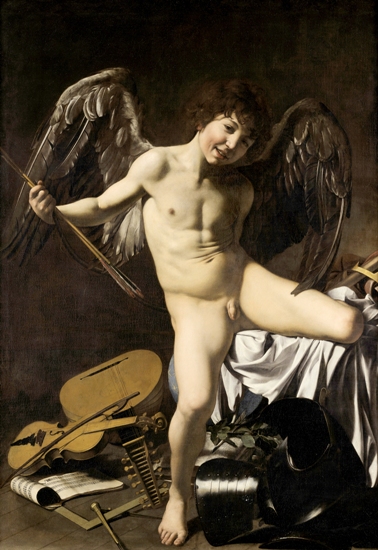 |
Gemäldegalerie, Berlin Victorious Cupid by Caravaggio (1601-1602) |
According to the artist and writer Giovanni Baglione (1566–1643), when Vincenzo Giustiniani acquired 'Victorious Cupid' by Michelangelo Merisi da Caravaggio (1571–1610) he found it 'so exquisitely painted that thereafter Giustiniani admired Caravaggio beyond reason'.
The Giustiniani brothers, Cardinal Benedetto (1554–1621) and Marchese Vincenzo Giustiniani (1564–1637), were outstanding as collectors in Rome, even in an age of great collectors. They were scions of a Genoese dynasty that had made its fortune in Eastern Mediterranean trade and banking and were leading figures in both the ecclesiastical and secular aristocratic realms. Marchese Vincenzo was a noted connoisseur and wrote perspicaciously on art.
The brothers' immense wealth gave them almost unlimited resources to buy and commission works. The inventory made at the time of Vincenzo's death listed nearly 600 paintings and more than 1,800 ancient sculptures. Our unusually detailed knowledge of the collection is owed to Vincenzo's commissioning of a monumental two-volume catalogue of engravings of it, and also the exceptional quantity of surviving documentation relating to it. An inventory of 1793 confirms that the collection of paintings was then still more or less intact.
Both brothers were patrons of Caravaggio, eventually becoming the owners of 15 paintings by the artist, including 'The Lute Player', 'The Inspiration of St Matthew' (1602, formerly Kaiser Friedrich Museum, Berlin, destroyed), 'Doubting Thomas' (c.1603, Sanssouci, Potsdam), 'The Crowning with Thorns' (c.1605, Kunsthistorisches Museum, Vienna) and 'St Jerome Penitent' (c1605, Museum of Montserrat). Among paintings now lost were 'Portrait of Fillide' (c.1598, formerly Kaiser Friedrich Museum, Berlin, destroyed) – the sitter was the renowned courtesan who regularly modelled for the artist – and ''The Agony in the Garden' (c.1604, formerly Gemäldegalerie Berlin, destroyed).
'Victorious Cupid' (1601–02) formed part of the largest single lot of 157 paintings in the sale of the Giustiniani collection in 1812, and was bought in 1815 from a dealer in Paris by the Prussian monarch Frederick William III, for his grand new public art museum in Berlin. In a rare loan, 'Victorious Cupid' has now travelled from the Gemäldegalerie in Berlin to the Wallace Collection in London for a modestly sized but stimulating exhibition, 'Caravaggio's Cupid', accompanied by a generously illustrated and enlightening catalogue by Helen Langdon, author of 'Caravaggio: A Life' (1998). In the 1638 inventory of the Giustiniani collection, 'Victorious Cupid' (Amore Vincitore) is described as 'Love laughing, as he scorns the world, and at whose feet lie various instruments, crowns, sceptres and pieces of armour, known on account of its fame as Caravaggio's Cupid'.
Vincenzo Giustiniani liked to hang his paintings by artist and school, and the brothers' collection, including some 120 other works, ranged from Ghirlandaio, Palmezzano, Palma il Vecchio, Raphael, Dosso Dossi, the Carracci, Reni, Domenichino, Lanfranco and Poussin to Lotto, Titian, Tintoretto and Veronese. In 1632 Joachim von Sandrart (1606–1688), the German artist and art historian, became the Giustiniani's curator. He relates how Caravaggio's Cupid was displayed in a gallery at Palazzo Giustiniani, in a dazzling coup de théâtre: 'At my suggestion it was given a dark green silk covering, and only when the others had been seen properly, was it finally exhibited, because it made all the other rarities seem insignificant, so that with good reason it could be said to eclipse all other paintings.'
Even today this painting of a full-frontal image of an entirely naked pre-pubescent boy is arresting. Such a picture would only have been conceivable at that time when dressed up, as it were, as a poetic trope, in this case 'Omnia Vincit Amor', the Virgilian concept of love conquering all. Here, Venus's little infant confederate has grown up into a fetching young boy. The credentials of Caravaggio's Cupid as a mythological figure are provided by bows, arrows and a set of full-sized angel's wings, a prop borrowed probably from his fellow artist Orazio Gentileschi (1563–1639) that also alludes to the eagle featured in the Giustiniani coat of arms.
The Dutch painter and art historian Carel van Mander (1548–1606) in 'Het schilder-boeck' of 1604 quotes Caravaggio as saying 'that all art is nothing but a bagatelle, child's work, no matter what it is or who it is by, unless it be painted, and that we cannot do better than to follow Nature'.
Nonetheless, the artist did not remain immune to the lessons of ancient sculptors, as his other few nude and more numerous semi-draped figures indicate. He was at one time or another resident in the palazzi of patrons – notably those of Cardinal Francesco Maria del Monte, Ciriaco Mattei and the Giustiniani – who offered him lodgings and studio space, and all of whom had large collections of classical sculptures and were knowledgeable about the ancient world. In the lost 'Agony in the Garden', for instance, the reclining pose of St Peter was based on that of an ancient marble of a River God in the Giustiniani collection. The current exhibition includes other illustrations of this influence on the artist's work, such as an Apollo from the 1st century BC–1st century AD and an Aphrodite from the 2nd century AD, and a room lined with a partial graphic recreation of the Giustiniani sculpture gallery.
The live model for 'Victorious Cupid' has now been reasonably securely identified as Francesco Boneri (documented in Rome 1602/3–1620), nicknamed Cecco, who entered Caravaggio's studio at this time at the age of about twelve and went on to become an accomplished Caravaggesque painter. Cecco was also the model for his master's entirely nude 'St John the Baptist in the Wilderness with a Ram', now at the Pincacoteca Capitolina in Rome, painted for Ciriaco Mattei around the same time as the 'Cupid'. The two canvases were clearly seen as related by contemporaries, among them the author and poet Francesco Scannelli (1616–1663), who wrote that the St John 'could not reveal truer flesh it if had been alive, like the Amoretto of Prince Giustiniani's collection'.
All Caravaggio's other young Baptists are semi-draped and the blatant nakedness of this exception could only have been rendered acceptable by the biblical setting – although some have suggested that the scene is actually related to the Old Testament story of the Sacrifice of Isaac (which would explain the ram rather than a lamb). An unusual aspect of both pictures is that the boy is depicted as smiling. A later traveller to Rome, the Englishman Richard Symonds (1617–1660) wrote of the 'Cupid': 'It was ye body & face of his owne boy or servant that laid with him.' But this was written nearly half a century later and all Caravaggio's amours and romantic escapades recorded at the time were strictly heterosexual. The rather awkward straddled pose of Cupid derives from that of a depiction of St Bartholomew in the 'Last Judgement' in the Sistine Chapel by Michelangelo (1475–1548), which is also a self-portrait, and a pornographic scene of an old man and a courtesan in a print by Agostino Carracci (1557–1602), allusions that would have amused Caravaggio's highly cultivated audience.
Victorious Cupid was the last mythological picture Caravaggio painted in Rome and, along with 'St John the Baptist in the Wilderness with a Ram', the most unashamedly erotic, whatever classical or biblical glosses have been attached to them. It has been plausibly suggested that the folded sheet below between Cupid's splayed legs represents female genitalia.
Caravaggio famously remarked to Vincenzo Giustiniani that 'it cost him as much labour to paint a still-life as it does to paint a picture with figures', and natura morta played a prominent part in many of Caravaggio's earlier works, such as 'Bacchus' (1597). Indeed, the Golden Age of the Roman still-life more or less began and ended with Caravaggio.
The still-life elements are especially rich and complex in 'Victorious Cupid', another reason why this opportunity to study this canvas at close hand is not to be missed. The heedless pleasure-seeker is depicted blithely trampling underfoot symbols of power: a crown and sceptre; military glory, in the form of darkly gleaming armour; architecture: a compass and mason's square; literature: a quill pen, manuscript and poet's laurel crown; and music, represented by abandoned instruments and a musical score. Part of a celestial sphere, painted with expensive lapis lazuli and gold peeps out just below Cupid's right buttock. This was a later addition and may have been at Vincenzo Giustiniani's instigation. The 'V's of the initial letter on the musical score and the architectural tools almost certainly refer to him.
There is only one known pure still-life by the artist, the celebrated 'Basket of Fruit' from the last years of the 16th century. But it is possible that the artist did one last independent example, symbolically imbuing it with a superabundance of erotic symbolism. The work in question is 'Still-life with Fruit on a Stone Ledge' thought to date from around 1603, not long after the 'Cupid'. It is a suggestive riot of succulent split pomegranates, melons, pumpkins and figs, probing, tumescent gourds and rosy, dimpled peaches like miniature buttocks. The canvas was spotted at auction in Spain in 1992 by the Florence-based American art historian John Spike. The black over-painted background was subsequently cleaned revealing a chiaroscuro and raking light typical of the artist during this period. It is now in a private collection.
Spike's belief that it is by Caravaggio was endorsed by the leading Italian expert on the artist, the late Mina Gregori. Such is the quality of this painting that if it is not by Caravaggio, almost the only other explanation is that it is the sole surviving work of a brilliant, otherwise completely unknown master.
Caravaggio's Cupid, The Wallace Collection, London, 26 November 2025–12 April 2026
'Caravaggio's Cupid' by Helen Langdon, The Wallace Collection, pp 111 £15.99
A fully illustrated version of this article can be found at:
https://britishartjournal.co.uk/caravaggios-cupid//
First published: British Art Journal: Online
© Roderick Conway Morris 1975-2026