 |
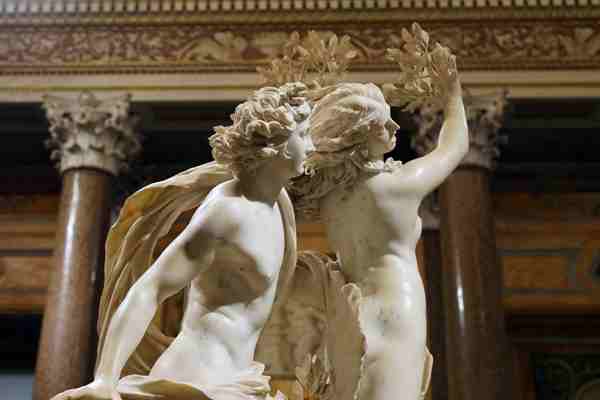 |
Galleria Borghese, Rome/photo Fabrizio Garrisi Apollo and Daphne (detail) by Gian Lorenzo Bernini (1598–1680), 1622–25 |
Metamorphoses: Ovid and the Arts
| By Roderick Conway Morris | London 12 May 2026 |
Christian writers had condemned the reading of pagan literature in general and Ovid in particular since the early days. Why, fulminated Marbod, Bishop of Rennes (c. 1035–1123), should children be beaten at school just so that they might learn about the debaucheries and adulteries of pagan gods, lascivious youths and unchaste girls? But the fascination of these classical texts proved too strong. With the rise of Humanism, the illustration of these works came to legitimize the nude and the erotic as subjects of art. Gods and goddesses could be displayed naked – even those who never appeared thus in antiquity – though normal human beings could not.
The Dutch painter and art historian Carel van Mander (1548–1606) in Het schilder-boeck ('The Book of Painters') of 1604 declared Ovid's 'Metamorphoses' 'a Bible for artists'. Its author, Publius Ovidius Naso, aka Ovid (43 BC–17 AD), was immensely popular in his lifetime, widely read in the Middle Ages and the favourite ancient writer of the Renaissance. 'Metamorphoses' is a poem in 15 books, and begins with the words: 'My purpose is to tell of bodies transformed into shapes of different kinds…and spin an unbroken thread of verse from the earliest beginnings of the world, down to my own times' (in Mary M Innes's trusty Penguin Classic translation). He delivers handsomely on his promise and, while including some 250 such transformations, the work also provides a unique encyclopaedic collection of Greek mythology and Roman legend stretching from the creation of the world down to the deification and death of Julius Caesar, which occurred just before the poet's own birth.
The Rijksmuseum in Amsterdam in Van Mander's homeland is now the venue for the first major exhibition of art inspired by Ovid's classic, and ranges from the ancient world and Renaissance to modern times. It features works by Bernini, Brancusi, Caravaggio, Correggio, Delvaux, Magritte, Poussin, Rodin, Rubens, Tintoretto, Titian and Veronese. The show is curated by Francesca Cappelletti and Frits Scholten, who are also the editors of the attractive catalogue. The exhibition will move on (with some variations) to the Galleria Borghese, that magnificent treasure house of the Baroque on the Pincian Hill in Rome.
Later Roman authors admired, freely imitated and borrowed from Ovid, as did the students and teachers in monasteries, schools and universities in the Middle Ages. The first translations of the Metamorphoses appeared in Italy (where a complete version dates to around 1339), France and Spain in the 14th century, in England and Germany in the 15th century and Dutch in the 16th (during which period multiple vernacular editions were published). Printed editions were adorned with wood engravings and, by the early 17th century, the images in some came to take precedence over the verses. This easy accessibility of Ovid's detailed and vividly related stories, even to those with little or no Latin, led to an explosion of artistic and literary works drawing on Ovid's poem.
Ovid was a master of ekphrasis – a description of any object but usually of a work of art. He was clearly interested in art, crafts and the technicalities and materials of the plastic arts, and some of these descriptions seem inspired by actual works he had observed. In Book II the poet's account of Apollo's palace and its stunning decorative schemes – of the gods, the heavens and the earth, the Seasons and the Zodiac – became a kind of manual of interiors for the builders of palaces in the 16th and 17th centuries. Those sky chariots driven by Apollo and Phaeton traversing vaulted ceilings came straight out of the pages of Ovid.
The opening scene in Book I of 'Metamorphoses', in which the cosmos emerges from 'a shapeless, uncoordinated mass, nothing but a weight of lifeless matter, whose ill-assorted elements were indiscriminately heaped together in one place', was tackled by only a few artists. The Caravaggesque artist from Bruges Louis Finson (1570/78–1617) in his bizarre 'Chaos or The Battle of the Four Elements' (1611) allegorized the event in four human figures: the dark man upper right represented fire; the pale woman upper left, air; the old bearded man, water; and the old woman, earth.
Constantin Brancusi in his 'Promethée' (1911) took an altogether more minimalist approach to a subsequent scene in Ovid's creation story. Prometheus, Ovid relates, fashioned the first humans from clay – for which he was later hailed as the mythical father of sculpture. Brancusi's white marble sculpture consists of a slightly pointy, egg-shaped form in which a face and ear seem just to have begun to emerge.
In describing living beings and the changes they undergo, Ovid often invokes art, especially sculpture, as when he relates the story of Narcissus staring into a pool at his own reflection: 'Spellbound by his own self, he remained there motionless, with fixed gaze, like a statue carved from Parian marble.' Caravaggio (1571–1610) captures this extended moment of stasis in his tenebrous 'Narcissus' (1597–98), a rare excursion for him into the pages of Ovid. 'Narcissus' was attributed to Caravaggio by Roberto Longhi in 1916, and following conservation and scientific research work carried out in the mid-1990s his authorship has been generally accepted.
Petrification is a common occurrence in the 'Metamorphoses'. Niobe, grief-stricken by the death of her children, ends up as a weeping statue, and it is the fate of the hapless Scylla to be transformed into a lump of rock treacherous to seafarers. The Gorgon Medusa's basilisk gaze can turn anybody and anything to stone. Her head remains able to effect this even after Perseus decapitates her. He weaponizes his macabre trophy, turning Atlas into a mountain when he attacks the hero and using it to petrify (literally) further enemies.
The outstanding Ovidian story of the reverse process was bound to be enticing as a theme for artists. One of the most celebrated examples is by Jean-Léon Gérôme (1824–1904), a painter and, after 1878, also a sculptor. His 'Pygmalion and Galatea' (c.1890) depicts the moment when Pygmalion's completed life-sized statue of a lovely young woman, with which he has fallen in love, comes to life: her upper torso and buttocks flush with pink as she turns into an animate being, and she bends to meet his embrace.
The work in Amsterdam is on loan from the New York Met and is one of the artist's three versions of the scene, each from a different angle: it will be joined in Rome by another, from the Pittas Collection in Cyprus. Auguste Rodin (1840–1917) also did a series of three marble versions of the same story. In one, from 1808–09 (also to be displayed in Rome), both the sculptor – a self-portrait of the artist himself – and his model appear to be emerging from the block of stone as though undergoing an Ovidian transformation before our very eyes.
The Galleria Borghese is the home of two Ovidian sculptural masterpieces by Gian Lorenzo Bernini (1598–1680), 'Apollo and Daphne' (1622–25) and 'The Rape of Proserpina' (1621–22). The former captures the moment when the fleeing nymph Daphne begins to be transformed into a laurel tree by her father, the river god Peneus, to escape the unwanted attentions of Apollo, who has fallen in love with her. Bernini complained about the difficulty of making a life-like portrait of a living person in white marble, the absence of colour giving 'the pallor of a person falling into a faint'. As seen in these two works, based on a careful study of Ovid's verses, he triumphantly surmounted this challenge. Among his achievements was his brilliant rendering of motion, even violent physical action. He told his son Domenico he had finally 'overcome the difficulty of making marble as pliable as wax'. And indeed, the verisimilitude of the yielding flesh of Proserpina's waist and thigh in the merciless grip of Pluto, as he carries her away to the Underworld, continues to astonish even to this day.
In the absence of the two Bernini masterpieces, the Amsterdam version of the exhibition does include the 'Sleeping Hermaphroditus' from the Louvre. Cardinal Scipione Borghese acquired this 2nd Century AD statue – based upon a story in Book IV of 'Metamorphoses' – shortly after it was excavated in 1619, and tasked Bernini with providing a base for it.
The artist carved in marble a contemporary mattress and pillow, transporting the figure from some ancient forest glade to a modern Baroque bedchamber. This ensemble had a room to itself at the Villa Borghese, where visitors approaching from behind – an arrangement mirrored in a specially created, theatrically lit, room at the Rijksmuseum – found a lissom young woman invitingly stretched out, only to discover on circling the figure that she/he had not only shapely breasts but also a penis. The statue was taken to France when it was sold by Camillo Borghese to Napoleon Bonaparte in 1807.
Of all the erotic figures and scenes from the lives of the gods, demigods, nymphs and humans in the pages of 'Metamorphoses' none were more delightful than the four 'Loves of Jupiter' painted by Correggio (c. 1489–1534) for Federico II Gonzaga, Duke of Mantua (1500–1540), between 1527 and 1531. Two of them, 'Jupiter and Io' and 'Danaë', are on display in Amsterdam and will be joined by 'The Rape of Ganymede' in Rome.
Metamorphoses: Ovid and the Arts, Rijksmuseum, Amsterdam, 6 February–25 May 2026, Galleria Borghese, Rome, 22 June–20 September 2026
'Metamorphoses: Ovid and the Arts,' Francesca Cappelletti and Frits Scholten, (eds), Hannibal, 352 pp €40
A fully illustrated version of this article can be found at:
https://britishartjournal.co.uk/metamorphoses-ovid-and-the-arts/
First published: Bristish Art Journal: Online
© Roderick Conway Morris 1975-2026