 |
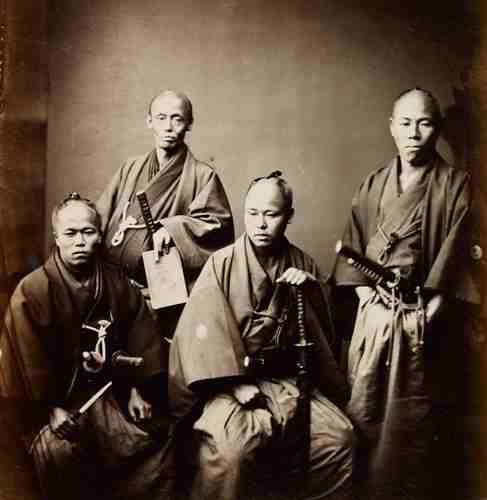 |
British Museum, London Satsuma's Envoys Extraordinary by Felice Beato, 1863–66 |
Samurai
| By Roderick Conway Morris | LONDON 25 March 2026 |
'The Japanese have their Bushido, or laws of the old Samurai warriors, just as we have chivalry or laws of the knights of the Middle Ages,' wrote Robert Baden-Powell (1857–1941) in his 'Scouting for Boys' in 1908.
Ironically, while medieval chivalry remained a romantic ideal in Edwardian Britain, in Japan itself the samurai had been abolished as a class over thirty years before, deprived of their stipends, forbidden to carry swords — dubbed 'the soul of the samurai' — and their code of honour supposedly consigned to oblivion. Yet, during this same period in the West there was unprecedented interest in their ethos, arms, dress and accoutrements.
The origins and historical development of this fascinating group, its rich and complex culture and surprisingly enduring global appeal today is unfolded in 'Samurai', a dazzling exhibition at the British Museum, and the title of a sumptuous catalogue, curated by Rosina Buckland and Oleg Benesch.
Japan's Imperial House traced its mythical lineage to the 8th century BC, even if the first documented incumbent on the throne only went as far back as the 5th century AD. But by the mid 12th century, the succession was frequently contested, leading to armed conflicts between rival clans and regions to secure the throne for their favoured candidates. The first warrior to secure a senior role at court, as Chancellor of the Realm, Taira no Kiyomori (1118–1181), married his daughter to the then Emperor and managed to secure the throne for his grandson.
But these years turned out to be a turning point in the history of Japan, as the warrior class rose to be the true rulers of the archipelago and the Emperors were relegated to a revered but purely symbolic role in the governance of the country.
In a series of battles on the shores of the Inland Sea west of the imperial capital Kyoto, the Minamoto, led by Minamoto no Yoritomo (1147–1199), vanquished their main rivals the Taira clan in 1185, driving them back into their ancestral lands. The original heartlands of the Minamoto were far to the west, near present-day Tokyo. Here, at Kamakura, they set up a permanent military government, later described by Japanese historians as a bakufu (literally 'tent government') under the rule of the shogun, literally the 'commander-in-chief'. This established a form of rule that was to endure for nearly 700 years.
During these earlier centuries, the shoguns' dominance was often contested, so the government remained a military dictatorship in which trained men at arms occupied all the key positions and martial skills were not infrequently called upon. Military units were organized as bushidan (warrior bands). Professional bushi were mounted bowmen, while part-time infantry were armed with bladed weapons. It was only later that the sword became more important than the horse and bow. These full-time warriors were also known as samurai (from the verb saburai, 'to serve'), which became the most common name for them outside Japan. Even today bushi is the standard term in Japan, while samurai describes the foreign perception of this group, which indeed came to define the popular image of traditional Japan.
The first Kamakura Shoguns were acutely aware that their long-term legitimacy could not rest on military might alone and that their parallel capital would have to compete in prestige with the imperial court also as an alternative cultural centre. This became even more acute after a retired emperor tried but failed to overthrow the Shogun in 1221 and the Emperor Go-Daigo (1288–1339) managed to re-assert imperial rule between 1333–1336, in the so-called Kenmu Restoration. This gave the warrior Ashikaga Takauji (1305–1358), who bolstered his claim to govern on account of his descent from the first Shogun Minamoto no Yoritomo, an opportunity to found a new Ashikaga Shogunate, with its headquarters on the doorstep of the imperial court at Kyoto.
After the Ashikaga Shogunate (1358–1573) succeeded in reaching accords with other regional warlords there followed a period during which the arts and culture thrived, as samurai philosophy now advocated 'the dual paths of literary and military arts'. Tea drinking had been introduced from China and successive Ashikaga Shoguns and the samurai played a prominent role in the cultivation of this increasingly elaborate social ritual, amassing a famous collection of the prestigious artefacts employed in it.
The Ashikaga Shogun Yoshimitsu (1358–1408) was a patron of poetry and assembled a notable collection of artworks and artefacts and employed experts to document them. He was sufficiently confident in his cultural credentials to invite the Emperor for a twenty-day visit to his villa in the north of Kyoto in 1408. His son Ashikaga Yoshinori (1394–1441) was no less sophisticated in his interests and hosted the young Emperor Go-Hanazono (1419–1471) in 1437.
Yoshinori opened diplomatic relations with China, which led to the large-scale import of Chinese ink paintings, ceramics, lacquer and bronzes, which became known as 'continental objects'. He also enabled a select group of artists and scholars to travel to China. Among them was the samurai-born Sesshu Toyo (1420–1506), who after three years of study there returned a master of the latest techniques in hatsuboku, or splashed-ink painting. Another samurai Kano Masanobu (1434–1530), who became the principal painter of the Ashikaga Shogunate, was a master of Chinese inspired colour painting and founded a dynasty of artists that was to last for 350 years. The Ashikaga Shoguns also followed the Imperial Court in their patronage of No theatre. This did not end happily for Yoshinori who was murdered in 1441 by a rival warlord who had invited him to attend a No performance.
Less centralized than that of Kamakura, the Ashikaga Shogunate devolved more authority to regional warlords, which led to extended periods of violence and instability later called the Warring States period (1467–1603). During this turbulent time a trio of commanding leaders emerged, who were later characterized by Japanese historians as the Three Great Heroes or Three Unifiers: Oda Nobunaga (1534–1581), Toyotomi Hideyoshi (1537–1598) and Tokugawa Ieyasu (1543–1616).
At the Battle of Sekigahara in 1600 Ieyasu defeated Hideyoshi's heir. Ieyasu was declared Shogun in 1603. He designated Edo, which had been a mere fishing village at the mouth of the Sumida river (indeed the original meaning of Edo was 'estuary'), as his capital. Edo's geographical position at the centre of Honshu, Japan's main island, made it ideal to command the whole country. He rebuilt a small castle there and excavated a network of canals connected to the Sumida River, reclaiming land for residential districts. However, his power was only secure when he crushed the final resistance of the Toyotomi at Osaka in 1615. The Tokugawa Shogunate was consolidated by Ieyasu's son Hidetada (1579–1632) and grandson Iemitsu (1604–1651).
The Shogunate owned around a quarter of all the agricultural land in Japan. It directly administered Edo, Kyoto, Osaka and Nagasaki. The rest of the country was run by about 260 regional lords, or daimyo, whose courts of various sizes staffed by samurai retainers mirrored that of Edo's. There were two classes of daimyo: those that had supported Ieyasu before the Battle of Sekigahara in 1600 and those that pledged allegiance subsequently. Only the former were eligible to serve at the Shogun's court.
The loyalty of the daimyo was guaranteed by the system of 'alternate attendance' (sankin kotai), whereby the daimyo had regularly to move their households to Edo for a year. In their absence from the capital, they had permanently to leave their wives and children there as hostages. These constant migrations cost from 50% to 70% of their annual income to prevent them from building up resources to rebel.
Although samurai and their families made up around 10% of the overall population of the country, Edo was the ultimate barracks town, half the population consisting of samurai at any given moment, occupying some 70% of the land area, the remainder left for townspeople and merchants. By the time of the census of 1721 Edo had a population of 1.3 million, the largest city in the world.
The final pacification of the country, which the Tokugawa achieved and maintained for 250 years, created problems of its own. The Shogunate had to find other occupations for these highly trained warriors, who alone were allowed to wear their trademark pair of long and short swords. Some became administrators, magistrates, tax collectors and land surveyors, descending according to rank to more banausic tasks, such as castle guards, warehouse supervisors, police officers and firefighters. There were even samurai women firefighters with their own distinctive uniforms.
While the upper echelons of the samurai elite could pass their idle hours cultivating their sensibilities, composing poetry and collecting and appreciating artworks and precious objets d'art, the lowlier ones supplemented their incomes through arts and crafts, pursuing such polite occupations as making umbrellas, fans, lanterns, lacquer and breeding rare birds. These activities contributed to the rich cultural and material life of the city. The alternate attendance system provided opportunities for visiting artists and craftsmen to familiarize themselves with the latest trends. And this constant bringing together of people from distant regions did much to forge a national identity.
Edo was overwhelmingly a city of bachelors and partly to meet their needs the Yoshiwara pleasure district was instituted in 1617, relocated forty years later to the north-eastern edge of the town. This produced a theatrical, entertainment and artistic culture of its own, recorded and celebrated in the inexpensive, colourful and wildly popular woodblock prints, or ukiyo-e (pictures of the Floating World). Famous beauties and renowned courtesans were also the subject of a high proportion of Floating World prints.
Whereas women occupied a decidedly subordinate position in Japanese society, they played a notable role as patrons, creators, consumers and connoisseurs of the arts in the samurai world. The women's quarters of the Shogun's Palace were administered by the women themselves.
Outstandingly the single most popular Japanese literary work was the 'Genji Monogatari' (The Tale of Genji) written by the woman author Murasaki Shikibu at the Heian Imperial Court in the 12th century. This was still proving an inexhaustible source of inspiration for narrative artists hundreds of years later. Interestingly, it had been written largely using syllabic letters, with a minimal number of Chinese characters, making it accessible to the largest possible audience. The use of the vernacular language and primarily the native syllabary was also a feature of some later mass-produced printed tales of epic stories from the Middle Ages.
Among the legendary samurai warriors featuring in these tales were some women. Most renowned of these was Tomeo Gozen, memorably depicted by Utagawa Kuniyoshi (1798–1861), who had more or less cornered the market in warrior pictures in the last days of the Tokugawa Shogunate.
In 1633 Tokugawa's grandson Iemitsu had instituted a policy of isolating Japan from the outside world, whereby foreigners were banned from entering the country and the natives from travelling abroad. There was severely limited trade via Chinese and Dutch merchants in Nagasaki. The minatory appearance of the 'Black Ships' commanded by the American Commodore Matthew C. Perry (1794–1858) off the coast of Japan in 1853 and 1854 spelt not just the end of the country's splendid isolation but also the Shogunate and the samurai. Other western powers joined the US in this gunboat diplomacy to force the 'Land of the Gods' to open itself to foreign trade.
When a British merchant Charles Lennox Richardson (1833–1862) travelling in the island of Kyushu failed respectfully to dismount from his horse at the approach of a daimyo and his retinue at Namamugi, the daimyo's samurai retainers cut him down. A Royal Navy punitive expedition bombarded Kagomisha, the castle town of the Satsuma domain, and compensation was demanded and paid.
Opposition to the Shogunate, which was steadily losing its grip on the country during the 1860s, coalesced around the Imperial House in Kyoto. In 1863 the Shogun travelled with an immense entourage to Kyoto to consult with the Emperor, the first such visit since the 1620s). When, five years later, an army led by the 15-year-old Meiji Emperor marched on Edo the last Tokugawa Shogun fled and retired to the dynasty's ancestral lands.
The daimyo were initially obliged to remain in Edo while their domains were converted to prefectures under new state-appointed governors. But the alternate attendance system was abolished. Many samurai departed for the regions, halving the population of Edo, now renamed Tokyo (Eastern Capital), by the summer of 1869.
The Meiji Restoration of 1868 led to the rapid westernization of the country's institutions. The bonds that the government issued to the samurai in lieu of their stipends soon became worthless and many fell into poverty. However, as the Japanologist Basil Hall Chamberlain (1850–1935), who was resident in the country between 1873 and 1911, commented in his remarkable one-volume encyclopedia 'Things Japanese' in 1905: 'The more clever and ambitious, on the other hand, practically constitute the governing class of the present day.' He also witnessed in January 1877 the final abolition of the right of the samurai to wear swords: 'The edict was obeyed by this strangely docile people without a blow being struck, and the curio-shops displayed heaps of swords which, a few months before, the owners would less willingly have parted with than life itself.'
Samurai, British Museum, London, 3 February–4 May, 2026
'Samurai' by Rosina Buckland and Oleg Benesch,, BM Press, 304 pp £30
A fully illustrated version of this article can be found at:
https://britishartjournal.co.uk/samurai-at-the-british-museum/
First published: British Art Journal: Online
© Roderick Conway Morris 1975-2026